Best Tools to Run Cable Through Walls for Home Installations
The best tool to run cable through walls depends on the route: fiberglass glow rods suit longer or narrow paths, while fish tape is designed to pull cable through conduit and bends. For a finished opening, a pass-through port or brush wall plate helps keep cables organized. The KOOTANS kit is best for adjustable reach, Fnvarak for a compact steel fish tape, and Klein Tools for measured conduit runs.
| Product | Best For | Type |
|---|---|---|
| KOOTANS 50-Foot Fiberglass Rod Kit | Long or narrow routing paths | Glow rods and accessories |
| Fnvarak 16.4-Foot Fish Tape | Indoor routes with bends | Spring-steel fish tape |
| Klein Tools 25-Foot Fish Tape | Tracking conduit length | Flat steel fish tape |
| matterform Cable Pass-Through Port | Creating an enclosed cable pathway | Wall pass-through |
| VCE Brush Wall Plate | Neat low-voltage cable exits | Brush wall plate |
KOOTANS 50-Foot Fiberglass Rod Kit

This kit is best for people who need adjustable reach for cable fishing through tight spaces, including suitable conduits and wall cavities. It includes 36 fiberglass rods, each 1.4 feet long, that can be joined to extend the tool up to 50 feet. Its bright yellow color helps distinguish the rods from other materials, and the listed low-friction design is intended to help them pass turns and joints.
Choose this if you want multiple short sections that can be assembled to suit the route. The product listing cautions against forcibly bending the rods, so do not treat them as a flexible cord that can be sharply curved.
Fnvarak 16.4-Foot Fish Tape

This fish tape is best for shorter indoor pulls where a firm guide can help navigate conduit or a route with bends. It uses spring-steel guide wire and measures 16.4 feet long and about 1/6 inch in diameter. The nickel-plated carbon-steel pulley head is designed to help the tape and attached cable move through conduits and bends with fewer snags.
Choose this if the expected run fits within its listed length and you want a steel guide rather than a modular fiberglass rod system. It offers less reach than the 25-foot Klein tape and the 50-foot KOOTANS kit, so check the route length before buying.
Klein Tools 25-Foot Fish Tape

This flat steel fish tape is best for users routing cable through conduit who want length markings to help track how much tape has been fed. It is 25 feet long and 1/4 inch wide, with firm yet flexible high-carbon spring steel. Laser-etched markings appear in descending one-foot increments, and the tape has a protective coating intended to reduce contact with moisture and humidity.
Choose this if a medium-length steel tape and visible measurements suit the job. Its listed length is shorter than the KOOTANS kit’s maximum extension, and a steel tape may not suit every tight or obstructed route.
matterform Cable Pass-Through Wall Port

This pass-through port is best for someone who wants a continuous, enclosed pathway across a wall rather than an exposed opening. Its full tube extends from one side of the wall to the other and is listed for walls 3 5/8 to 5 1/4 inches thick. The maker says it accommodates common cable types, including HDMI, coaxial, Ethernet, and two- or three-prong power cables. The white surface can be painted to match the room.
Choose this if the wall thickness and opening requirements match the installation. It is a pathway component, not a cable-pulling tool, so a fish tape or rod may still be needed to route cable through a difficult cavity.
VCE Brush Wall Plate Two-Pack
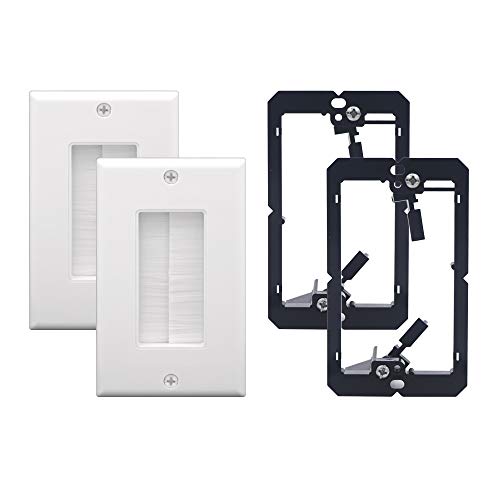
This brush wall plate is best for finishing a low-voltage cable exit, such as one used for HDMI, coaxial, audio-video, speaker, or network cables. The brush opening lets cables pass through while covering the wall opening, and the set includes two plates with brackets. The product listing specifies ABS material described as durable and flame-retardant.
Choose this if you want a tidy cable opening at the wall surface. Unlike the matterform port, it does not provide a fully enclosed tube through the wall; it is a finishing plate, not a tool for fishing cable.
Buying Guide: How To Choose A Wall Cable Tool
Do you need to pull cable or finish the opening?
Fish tape and glow rods help guide or pull cable along a route. A wall port or brush plate manages the finished opening. These products serve different stages of the job, so first decide whether you need to navigate the wall, cover an opening, or both.
How long and complicated is the route?
Compare the tool’s listed reach with the route, and account for turns or obstructions. KOOTANS offers joinable rods up to 50 feet; Fnvarak lists a 16.4-foot fish tape; Klein Tools lists a 25-foot tape with length markings. No tool guarantees passage through every wall cavity or conduit.
What kind of cable and wall finish do you need?
For a clean exit, a brush plate is suited to low-voltage cables, while a full tube port creates an enclosed path. Check the product’s stated cable types and wall-thickness range. Do not assume a wall plate or pass-through accessory makes every cable type safe to route inside a wall.
Before cutting or fishing through a wall, identify potential wiring, plumbing, and other obstructions. Follow applicable electrical codes and cable-manufacturer instructions. Power wiring and low-voltage wiring can have different requirements; consult a qualified electrician when the route or cable type is uncertain.
Frequently Asked Questions
What tool is commonly used to pull cable through a wall?
Fish tape or fiberglass glow rods are commonly used to guide cable through conduit or suitable wall routes. Select one based on the route length, bends, and available access.
Is fish tape or a glow rod better?
Fish tape offers a continuous steel guide, while glow rods connect in sections and can provide greater adjustable reach. The better choice depends on the route and the tool’s listed length.
Can a brush wall plate pull cable through a wall?
No. A brush wall plate covers and organizes a cable opening. Use a suitable pulling tool to route cable through the wall before installing the plate.
Can any cable go inside a wall?
No. Wall-use requirements depend on cable type and local rules. Verify the cable’s rating and installation requirements before routing it inside a wall.
Do I need a wall pass-through and a fish tape?
Possibly. A fish tape can help route cable, while a pass-through port or brush plate finishes the opening. The appropriate combination depends on the wall design and installation plan.