Best Stand Up Belt Sander Options for Woodworking and DIY
If you’re seeking a stand up belt sander for precision edging, contour work, or rapid material removal, these five models offer solid performance, varying dust collection, and adaptable layouts. This guide helps you compare options and pick a sander that fits your shop. Best for hobbyists and small shops who need reliable, space-saving stand-up designs.
Summary table of chosen products:
| Product | Key Benefit | Best For |
|---|---|---|
| WEN 6502T | Two-in-one belt and disc, cast iron base | Versatile setups and stable operation |
| Woodskil Belt Disc Sander Combo | Solid steel base, dual dust ports | Contour work with clean dust control |
| WEN 6524 | Oscillating belt and spindle, compact | Limited footprint projects and sanding curves |
| Jellas Handheld Belt Sander | Lightweight, handheld option with dust bag | Portability and quick touch-ups |
| VEVOR 5″ Disc + 1″ x 30″ Belt | Dual sanding with 0–45° tilt and dust ports | Small to medium projects with dust control |
WEN Benchtop Belt and Disc Sander With Cast Iron Base

The WEN 6502T combines a 4-by-36 inch belt with a 6-by-6 inch disc in a single unit. The belt tilts from 0 to 90 degrees for versatile sanding angles and easy deburring. The heavy cast iron base minimizes vibration for smoother finishes. Best for: woodworkers who need a stable, dual-function machine for flat stock, shaping, and chamfering. Caution: belt and disc alignment should be checked periodically to maintain accuracy.
Woodskil 4.3A Belt Disc Sander Combo

The Woodskil model features a 4×36 inch belt and a 6 inch disc, with a steel base and dual dust ports. It operates at 3570 RPM for fast material removal and includes two sandpapers and a miter gauge for contour work. Best for: hobbyists who want a robust, dual-sanding setup with enhanced dust control and accuracy aids. Limitation: assembly and belt tracking may require careful setup for first use.
WEN 6524 Oscillating Belt and Spindle Sander

The WEN 6524 pairs a belt sander with a spindle sander, offering oscillation for extended reach and rounded edges. This model is compact enough for limited shop space while delivering material removal on flat and curved surfaces. Best for: users who need a versatile, smaller footprint unit that handles both belt sanding and spindle tasks. Caution: spindle functionality may require occasional looseness checks on the track.
Jellas 7Amp Handheld Belt Sander
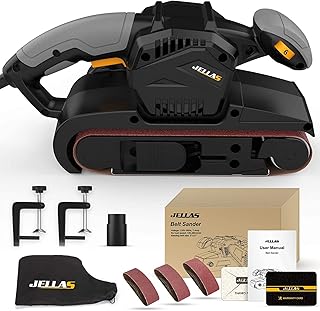
The Jellas handheld model is a compact 3-1/2 inch by 11 inch sander with variable speed, a dust bag, and a 10-foot power cord. It is designed for handheld finishing tasks and quick touch-ups rather than heavy stock removal. Best for: on-the-go projects or tight spots where a full benchtop setup isn’t practical. Limitation: lack of a fixed base makes precise flat-surface work more challenging.
VEVOR 5″ Disc Sander & 1″ x 30″ Belt Sander

The VEVOR unit combines a 5″ disc sander with a 1″ x 30″ belt sander. It offers a 0–45° tilting worktable and two dust ports for cleaner workspaces. Best for: small workshops needing a compact, budget-friendly stand-up belt disc combo with adjustable angles. Caution: smaller belt width may limit heavy stock removal on wide boards.
Buying Guide: Key Considerations for Stand Up Belt Sanders
What should you check when choosing a stand up belt sander? Consider belt size and torque, base stability, dust collection, and the ability to tilt the belt or swap to a disc for different tasks. If you work on wide boards, prioritize a larger belt (4×36 inches or similar) and a sturdy, vibration-reducing base. If space is tight, look for compact footprints and integrated dust ports for a cleaner shop.
How important is dust collection? For finish work and long sessions, two-port dust collection or an efficient vacuum hookup reduces airborne dust and improves finish quality. Some models include dust bags or vac adapters; others require an extra attachment. Decide whether you need a dedicated dust port or a basic bag system.
Do you need dual functionality? Bilateral sanders (belt plus disc or belt plus spindle) save time and space. If your tasks involve shaping curves or bevels, a unit with a tilting belt or a built-in spindle option can be advantageous. If you primarily deburr or flatten large panels, a belt-focused model may suffice.
What about speed and control? Higher belt speeds remove material quickly, but finer finishes benefit from slower belt rates or variable speed control. Check motor amperage and RPM specifications to ensure the sander meets the texture demands of your typical projects.
Frequently Asked Questions
- What is a stand up belt sander best used for? For flattening, shaping, beveling, and contour work on flat or edge surfaces, with the benefit of standing up for better posture and visibility.
- Can a belt sander be used on curved surfaces? Yes, especially models with a disc or spindle option and a tilting belt that allow contour sanding.
- Is dust collection essential with sanding? Yes, it helps maintain finish quality and health in the workspace; choose models with dual ports or compatible vac adapters when possible.
- Should I choose a belt-only or belt-disc combo? Choose a belt-disc combo if you frequently switch between flattening edges and disc sanding; otherwise a belt-only model can be simpler and lighter.
- What should I consider for shop space? Look for a compact footprint and a stable base to minimize vibration and maximize accuracy in limited spaces.
- Are cheaper models reliable? Budget models can perform well for light to moderate tasks, but ensure the base is sturdy and the belt tracking stays accurate under load.