Best Skill Saw Blades for Metal Cutting
The best skill saw blade for metal depends on the material, cut type, and blade specifications your saw accepts. The Diablo Steel Demon is best for buyers prioritizing stated durability and cooler cutting; FOXBC’s 48-tooth blade suits common metal-cutting tasks, while its 70-tooth option offers more teeth. KURSTOL emphasizes reduced vibration, and the 68-tooth DW3329 is a higher-tooth-count alternative. Check the blade diameter, arbor, maximum RPM, and material limits before buying.
| Blade | Best For | Key Listed Detail |
|---|---|---|
| Diablo Steel Demon D0748CF | Durability-focused cutting | 48 teeth; Cermet II |
| FOXBC 48-Tooth | Specified metal stock | 5/8-inch arbor; 5800 max RPM |
| FOXBC 70-Tooth | More teeth per cut | 70 teeth; 5800 max RPM |
| KURSTOL 48-Tooth | Vibration-conscious cutting | Laser grooves |
| DW3329 68-Tooth | Buyers seeking a higher tooth count | Coated blade body |
Diablo Steel Demon D0748CF
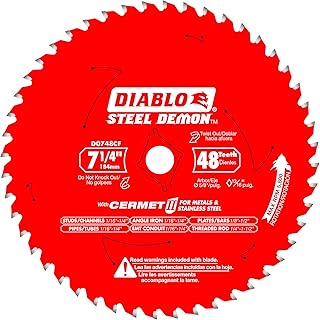
This 7-1/4-inch blade has 48 triple-chip-grind teeth, Cermet II cutting tips, and a Perma-Shield coating. It is designed for medium metal cutting. The listed features emphasize heat tolerance, hardness, wear resistance, and reduced friction from the coating.
Best for: Buyers who want a metal-cutting blade positioned around durability and cutting temperature. The manufacturer’s stated comparisons describe cuts as cooler and faster than standard grinding discs, and claim longer life; these are comparisons to grinding discs, not to other saw blades.
Consider: The supplied features do not state the arbor size or maximum RPM. Confirm both against your saw and its manual before use.
FOXBC 48-Tooth Metal Cutting Blade

This 7-1/4-inch cermet carbide-tipped blade has 48 teeth, a 5/8-inch arbor, a .075-inch kerf, and a listed maximum speed of 5800 RPM. The features specify use on steel studs and channel, angle iron, EMT conduit, all-thread, plates, bars, and rods within stated size ranges. The listing says it is compatible with corded and cordless circular saws.
Best for: Buyers whose metal stock matches the listed thickness and diameter limits and whose saw matches the blade’s arbor and RPM specifications. Those details make it easier to compare against a particular cutting task.
Consider: Check the stated material limits carefully: the listing gives different ranges for tubing, plates and bars, and rods. Do not assume the blade is suitable for stock outside those ranges.
FOXBC 70-Tooth Metal Cutting Blade

This 7-1/4-inch ceramic carbide blade has 70 teeth, a .075-inch kerf, a 5/8-inch arbor, and a listed 5800 RPM maximum. Its stated applications and stock-size ranges match the FOXBC 48-tooth listing, including steel studs and channel, angle iron, EMT conduit, plates, bars, and rods.
Best for: Buyers comparing tooth counts who want the listed 70-tooth configuration for the specified metal materials. It offers 22 more teeth than the FOXBC 48-tooth option while sharing the listed diameter, arbor, kerf, and maximum RPM.
Consider: Tooth count alone does not establish cut quality or speed. Verify the stock limits and saw specifications, and choose based on the job rather than assuming more teeth are always better.
KURSTOL 48-Tooth TCT Blade

KURSTOL’s 7-1/4-inch blade has 48 tungsten carbide-tipped teeth, a 15.87 mm arbor, and a stated 1.4 mm blade thickness. Its listing describes alternating top bevel teeth for metal and laser-cut grooves intended to absorb noise and reduce vibration for stable cutting. Listed materials include steel, iron, nickel, titanium, ferrous metals, and steel pipe.
Best for: Buyers looking for a 48-tooth blade whose listed design includes vibration-reducing grooves and a range of metal applications.
Consider: The provided features do not specify maximum RPM or allowable stock thickness. Confirm operating limits and material suitability with the product details and saw manual before cutting.
DW3329 68-Tooth Metal Cutting Blade

The DW3329 is a 7-1/4-inch, 68-tooth metal-cutting blade. Its listed features include precision-sharpened teeth for fast, smooth cuts, a coating intended to prevent rust and reduce friction, and a thicker body for durability in heavy-duty applications.
Best for: Buyers comparing higher tooth counts who also value the listed coated blade body and thicker construction.
Consider: The supplied product information does not identify the arbor size, maximum RPM, or specific metal thickness limits. Confirm these specifications before selecting it for a saw or job.
Buying Guide: How to Choose a Metal-Cutting Skill Saw Blade
Does the blade fit your saw?
Start with the saw manual and blade markings. Match the blade diameter and arbor, and make sure the blade’s maximum RPM is at least as high as the saw’s operating speed. The listed FOXBC blades specify a 5/8-inch arbor and 5800 RPM maximum; other products here require checking their full specifications.
Which tooth count should you choose?
The options listed range from 48 to 70 teeth. A higher tooth count is a useful comparison point, but it does not by itself guarantee a smoother cut, faster work, or suitability for a particular material. Compare the blade’s stated application and stock limits with the metal you plan to cut.
What material and thickness will you cut?
Match the blade to the material and dimensions. FOXBC provides specific ranges for tubing, plates and bars, and rods. KURSTOL lists several metal types but the provided features do not give stock thickness limits. If a limit is not specified, consult the complete product information rather than guessing.
What other features matter?
Compare tooth material and grind, coating, kerf, and construction details where listed. Diablo highlights Cermet II teeth and Perma-Shield coating; KURSTOL lists laser grooves; and the DW3329 lists a coated body and thicker construction. Choose based on the feature relevant to your work, not a feature name alone.
Frequently Asked Questions
Can I use any 7-1/4-inch blade on a skill saw?
No. Diameter is only one requirement. Check the arbor, maximum RPM, saw manual, and the blade’s intended material and operating limits.
Is a metal-cutting blade the same as a grinding disc?
No. The Diablo listing describes its saw blade as an alternative to standard grinding discs and compares their stated cutting performance. They are different products, so follow the blade and saw instructions for use.
Should I choose a 48-tooth or 70-tooth blade?
Compare the specified applications and your job requirements. The supplied information does not establish that one tooth count is universally better.
Do these blades cut stainless steel?
The Diablo and FOXBC 48-tooth product names and features refer to stainless steel cutting. Check each blade’s full instructions and limits for the specific stainless stock you plan to cut.
What should I verify before cutting?
Confirm blade fit, RPM limits, material suitability, and stock dimensions. Follow the saw and blade manufacturers’ safety instructions and use appropriate protective equipment.