Best Rail Saw for Tile: Top 5 Systems for Accurate, Efficient Cuts
Answering your search for a reliable rail saw for tile, this guide highlights five high-performing options that help you achieve straight, precise cuts on ceramic, porcelain, and stone. Each pick suits different project sizes and budgets—from large-format tile installations to versatile bevel and chamfer cuts. The best buyers are professionals tackling large floors, DIYers upgrading to larger tiles, and contractors seeking stable, tool-assisted accuracy. Below is a quick summary to compare core strengths.
| Product | Best For | Key Strength |
|---|---|---|
| 2300W Electric Tile Cutting System with 71″ Rail Guide | Large-format tile projects | Ultra-long rail for oversized tiles and dual rails for straight cuts |
| MUFASHA Angle Grinder Tile Cutter with 78″ Rail | Versatile straight and bevel cuts | Dual-cutting modes and strong suction-assisted guide rails |
| Rubi DCX-250 1550 Xpert 61″ Rail Saw | Precision cuts with stability | Triple beam system with reinforced chassis |
| Manual Floor Tile Cutter 48 inch | Budget-friendly, on-site straight cuts | Double guide rails and heavy-duty frame |
| FLEX CS 40 Wet Tile Saw | Wet cutting with compact blade setup | High speed and tilting cutting capacity |
2300W Electric Tile Cutting System With 71 Inch Rail
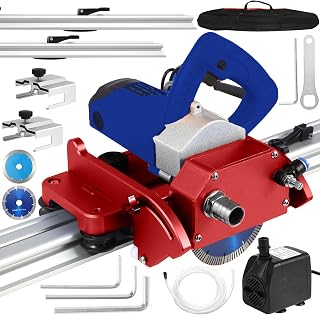
This rail saw system targets demanding tile projects with a 2300W motor delivering up to 8000 RPM. It supports wet and dry cutting, which is ideal for both ceramic and stone materials. Best for professional contractors handling large-format tiles where fast, clean passes reduce rework and improve efficiency. The 71″ rail design minimizes repositioning and helps maintain straight lines across wide surfaces. A dual-rail setup enhances stability, while the water feed kit helps cool the blade during long sessions. Suction base and clamps add worksite stability, though setup may require a solid flat surface.
Who it’s best for: professionals and advanced DIYers working on large installations. Caution: heavier weight and setup complexity can be a consideration for very small workspaces.
MUFASHA Angle Grinder Tile Cutter With 78″ Rail

This cutter leverages a robust 1400W angle grinder and 8500 RPM to deliver precise cuts in ceramics and porcelain. It offers straight and bevel cutting plus chamfer options, enabling diverse tile layouts without swapping tools. The two 1-meter rails feature three-suction cups and fixed clamps, which provide stable guidance for accurate outcomes. Best for: projects requiring both straight and angled cuts with reliable on-cut measurements. Limitation: the tool’s weight and grinder form factor may be less ideal for very tight spaces.
Rubi DCX-250 1550 Xpert 61″ Rail Saw

Rubi’s DCX-250 combines a reinforced aluminum chassis with a triple beam system to enhance stability and cut cleanliness. It offers high-precision mitering with height adjustment and a ZERO DUST feature for cleaner operation. Best for: users who value stability and dust control on mid-to-large tile jobs. Better for: those needing precise miters and a solid, long-lasting frame. Caution: installation and setup might require careful alignment to maximize the zero-dust benefits.
FLEX CS 40 Wet Tile Saw

The FLEX CS 40 offers a wet cutting approach with no-load speed up to 12,000 RPM. It uses a 5″ x 7/8″ blade and a 20mm adapter ring, with a tilting range of 0-45 degrees. Best for: compact wet-cutting tasks and small-to-medium tile projects where precision and mess control matter. Caution: smaller blade size may limit the depth of cut on thicker tiles.
Buying Guide: Key Considerations For Rail Saws For Tile
What cuts do you need? For large-format, wall-to-floor installations, prioritize long rails, dual rails, and a robust motor. For versatility including bevels and chamfers, look for dual-cutting modes and adjustable rails. Wet-cut capability helps with porcelain and stone to reduce dust and blade heat. Stability matters—check suction bases, clamps, and rail materials (aluminum or aluminum dual-rail systems) for consistent straight cuts. Consider weight, portability, and the space available on site.
What should I watch for in rail saws?
Blade compatibility, maximum cutting depth, and ease of blade changes influence efficiency. A solid chassis with minimal rail flex yields cleaner cuts. Dust management and water handling are critical when cutting stone or porcelain to preserve blade life and accuracy.
Is a manual rail cutter enough for large tiles?
Manual cutters can handle straight cuts on large tiles but may lack the speed and uniformity of powered rail saws. They are typically more budget-friendly and portable, best for straightforward tasks or on-site adjustments.
How important is a dust control feature?
Dust control improves air quality on site and keeps the tile surface cleaner for accurate measuring. Models with a “ZERO DUST” system or dust extraction compatibility offer tangible benefits for long sessions.
Which features maximize accuracy?
Stable guide rails with suction or clamps, precise height adjustment, and a solid aluminum frame reduce deviation. Dual rails and triple-beam constructions further enhance cut straightness and repeatability.
What about maintenance and upkeep?
Regularly check rails for straightness, clean the guide paths, and inspect clamps and suction cups for wear. Lubricate moving parts per the manufacturer’s recommendations to maintain precision over time.
Buying quick reference: Which one is right for you?
- Largest format tiles and workflow speed: 2300W Electric Tile Cutting System with 71″ Rail
- Versatile straight and bevel with high stability: MUFASHA Angle Grinder Tile Cutter with 78″ Rail
- Maximum stability and dust control: Rubi DCX-250 1550 Xpert 61″ Rail Saw
- Budget-friendly, on-site straight cuts: Manual Floor Tile Cutter 48 inch
- Compact wet-cutting capability: FLEX CS 40 Wet Tile Saw
Frequently Asked Questions
- Q: Do rail saws require special blades? A: Yes, use blades compatible with ceramic, porcelain, or stone and ensure the blade width matches the cut depth and guide clearance.
- Q: Can these tools cut glass tile? A: Some models can handle glass with appropriate blades and settings, but always verify blade compatibility and manufacturer guidance.
- Q: Is wet cutting necessary for porcelain? A: Wet cutting reduces dust and blade heat, improving blade life and cut quality.
- Q: Are long rails harder to maneuver on small jobs? A: Yes, but many models offer retractable or modular rails to accommodate smaller spaces.
- Q: Which feature most improves accuracy? A: A solid, rigid rail system with strong suction/clamps minimizes deviation and maintains a straight path.