Best Oscillating Belt and Spindle Sander Options for Woodworking
Answering the common search: these oscillating belt and spindle sanders combine belt and spindle sanding to handle curves, contours, and flat surfaces in one machine. They’re best for DIY woodworkers, hobbyists, and professionals who want versatile finishing in tight spaces or on complex parts. Below are five top-shelf options with quick suitability notes and a compact buying table to compare core attributes at a glance.
| Product | Best For | Key Feature |
|---|---|---|
| WEN 6524 Oscillating Belt and Spindle Sander | Versatile projects; beginners to intermediate | 5 drum sizes + 4×24 belt |
| 4A Variable Speed Oscillating Belt and Spindle Sander | Detailed work; furniture refinishing | 1000-1800 RPM; 29-58 OPM |
| VEVOR Oscillating Belt and Spindle Sander | Flexible workpieces; general woodworking | 2400 RPM; 5 sleeves; tilting table |
| Vertical Oscillating Spindle Sander & Belt Sander (VroomAuto) | Dual-action tasks; quick switch between modes | 500W motor; 1575 FPM belt; 2000 RPM spindle |
| RIDGID EB4424 Sander | Edge sanding; compact setup | Oscillating edge style |
WEN 6524 Oscillating Belt and Spindle Sander
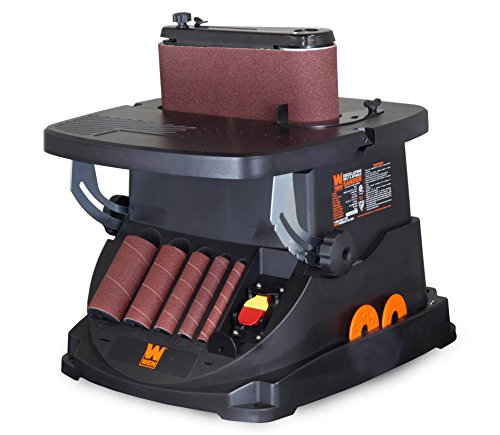
The WEN 6524 combines belt and spindle sanding in a compact benchtop layout. It includes multiple drum sizes (1/2″, 3/4″, 1″, 1-1/2″, and 2″) and a 4 x 24″ belt, with belt speeds up to 1575 FPM and spindle speeds to 2000 RPM. The 3.5-amp motor oscillates at 58 cycles per minute with a 5/8″ stroke. Best for hobbyists tackling curved profiles and small to medium flat surfaces. Caution: ensure workpiece depth fits the table and belt width for best results on tight curves.
Who it’s best for: beginners to intermediate woodworkers needing reliable belt and spindle capability in one machine.
4A Variable Speed Oscillating Belt and Spindle Sander

This model offers dual sanding modes (belt and spindle) with a 4×24″ belt and five drum sleeves. It features a broad speed range (1000-1800 RPM) and 29-58 OPM, making it adaptable for detailed furniture refinishing or edge work. Best for professionals and serious hobbyists who need flexible speed control and a wide assortment of sleeves. Caution: heavier units may require stable mounting and space planning in smaller shops.
Who it’s best for: those who frequently switch between contour work and flat-surface shaping and want broad sleeve variety.
VEVOR Oscillating Belt And Spindle Sander
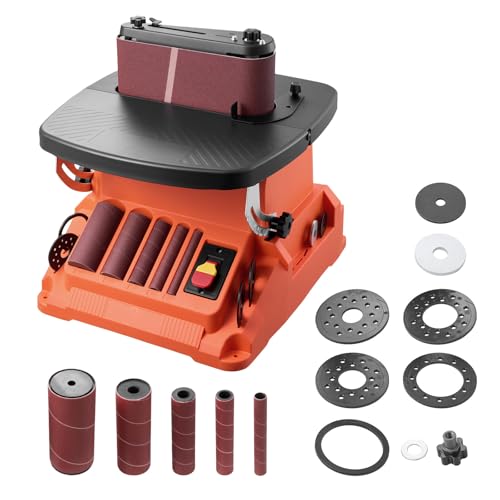
Powered at 2400 RPM with a 5/8″ stroke and 58 OPM, this benchtop unit combines belt and spindle sanding with a tilting worktable. It includes a complete kit: 24″ x 3.86″ belt, five sleeves (1/2″ to 2″), and table inserts for different workpieces. Best for versatile shop setups that need rapid piece changes and efficient dust management through dependably integrated dust paths. Limitation: higher speed can require tighter control and dust collection adjustment for small parts.
Who it’s best for: homeowners and woodworkers seeking a flexible, all-in-one sander with a tilting table for angled pieces.
Vertical Oscillating Spindle Sander & Belt Sander (VroomAuto)

This 2-in-1 machine emphasizes dual-action sanding with a 500W motor delivering 58 oscillations per minute and belt speeds up to 1575 FPM, plus spindle speeds around 2000 RPM. It ships with five sleeves (1/2″ to 2″) and a 4″ x 24″ belt. Best for rapid transition between belt work and contour sanding on curved surfaces. Caution: heavier footprint means it’s best placed on a stable bench or stand.
Who it’s best for: users who want quick mode switching without changing machines or jigs.
RIDGID EB4424 Sander, Oscillating/Edge Belt

RIDGID EB4424 emphasizes an oscillating edge belt design, suitable for edge finishing and detail work. It’s labeled as a sander for power-detail tasks with a Taiwan-origin build noted in its listing. Best for users who specifically need edge-sanding capability in addition to general contour work. Limitation: concise description makes it less clear about belt sizes and full spindle options; verify compatibility with your shop needs before purchasing.
Buying Guide
What to consider before buying
Key factors include belt width (common 4×24″), spindle stroke (usually 5/8″), motor power (3.5–5 amps or 500W+), oscillation rate (OPM), and belt/spindle speed ranges. A tilting table can help when sanding at angles, and onboard dust collection ports simplify cleanup.
How to choose by task
For detailed curves and contours, prioritize models with versatile sleeve sets and high spindle RPM. For flat-surface shaping, ensure belt speed is sufficient and that the machine provides solid sanding belt alignment and table support. If you work with large pieces, check belt dimensions and the machine’s weight and stability.
Dust management and workspace setup
Look for integrated dust ports and the ability to connect a dust collector. A compact footprint helps in small shops, but ensure stability and vibration control. Consider a machine with onboard accessories storage to keep belts and sleeves organized.
Power, speed, and ergonomics
Higher speed and torque improve material removal, but can reduce fine control. Variable speed options add versatility for different woods and finishes. Ergonomics matter for long sanding sessions; consider a model with comfortable access to switches and accessible belt changes.
FAQ
- What is an oscillating belt and spindle sander used for? It combines belt sanding for flat or curved surfaces with spindle sanding for contours and interior details, enabling smooth finishes on diverse workpieces.
- Do these machines come with dust collection ports? Many do, but availability varies by model. Check the product description for dust port size and compatibility with your dust collector system.
- Is a variable speed feature important? Yes, it adds control for different woods and finishes, reducing scorch risk on soft woods and improving finish quality on hardwoods.
- What belt size should I expect? Commonly 4×24 inches, but confirm the belt width and length to ensure compatibility with replacement belts you already own.
- Can I use these machines for professional woodworking? Yes, several models balance power, versatility, and durability suitable for more demanding tasks, depending on the project scope.
- What safety practices are recommended? Always wear eye and hearing protection, secure the workpiece, and use push sticks or fixtures for small parts to avoid kickback or contact with moving parts.