Best Multi Tool Blades for Grout Removal and Tile Repair
Diamond-grit oscillating blades are the most suitable choice here for removing grout and cleaning mortar from tile joints. The LEILUO set is best for switching between straight runs and corners, EZARC suits precise narrow cuts, and XXGO is designed for 1/8-inch grout lines. The Goldblatt is a hand tool rather than an oscillating blade, while the WORKPRO set is intended for metal and wood—not grout—so check the limitations before choosing either.
| Product | Best suited for | Important distinction |
|---|---|---|
| LEILUO 6-Piece Diamond Set | Straight grout lines and corners | Flat and curved blades; 2.0 mm thick |
| EZARC 3-Pack | Precise grout and mortar removal | Approximately 1/16-inch kerf |
| XXGO 20-Piece Set | 1/8-inch grout lines | Not recommended for 1/16-inch lines |
| Goldblatt Grout Tool | Manual, targeted grout cleanup | Hand tool, not an oscillating blade |
| WORKPRO 23-Piece Set | General wood and metal cutting | Not identified as a grout-removal set |
LEILUO Diamond Grout Removal Blades

Best for: Tile repairs that include both straight grout joints and tight corners. This six-piece diamond-grit set includes flat blades for straight lines and curved blades for angled or confined areas. Its 2.0 mm thickness is also listed for removing residual wall adhesive and dried thin-set from a substrate.
The product is described as suitable for controlled detailing rather than heavy demolition, and its diamond edge is intended for grout, mortar, and dried thin-set. It is selected for the range of blade shapes and the stated emphasis on controlled removal.
Limitation: The features describe a detailing blade, not a heavy-demolition option. Use it cautiously around tile edges and avoid forcing the blade.
EZARC Diamond Oscillating Blades

Best for: Precise work in narrow joints, corners, and edges. EZARC lists an approximately 1/16-inch kerf, making this three-pack a better fit when a controlled, narrow cut matters. The diamond edge is intended for defective grout, mortar, plaster, and porous concrete.
The product listing says the blades are designed for tough applications and claims up to five times the life of carbide-grit blades. That claim is product-provided information, not a guarantee of service life in every material or job. The stated narrow kerf and corner access are the main reasons to consider this set.
Limitation: A narrow kerf may not match wider grout joints. Confirm the joint width and blade fit for your tool before buying.
XXGO 20-Piece Diamond Blade Set
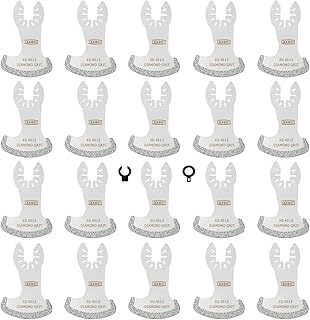
Best for: Repeated removal along 1/8-inch grout lines. This 20-piece set is specifically described for that joint width and lists a blade thickness of about 2.3 mm. Choose it if your grout joints match the stated size and you want multiple blades for the project.
Its clear joint-width guidance makes it easier to compare with narrower options such as EZARC. The product information explicitly says it is not for cutting tile, granite, or hard walls, so it should be used for grout removal rather than those materials.
Limitation: The listing says it is not best for 1/16-inch grout. Avoid choosing it for very narrow joints or assuming it can cut tile or granite.
Goldblatt Manual Grout Removal Tool
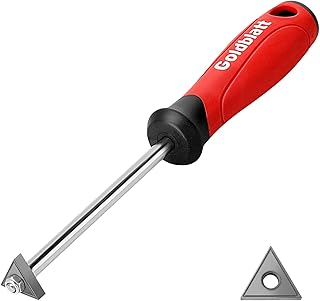
Best for: Buyers who want a manual option for targeted grout cleanup rather than an oscillating attachment. The listing describes a triangular edge, a fine-groove pattern, and a replaceable carbide tip. It is also presented for tile-joint repair, caulk removal, and mortar cleanup.
This tool is included as a related grout-removal option, not as a multi-tool blade. Choose it if you prefer a hand-operated tool for controlled, localized work or need a tool specifically described for joint repair.
Limitation: It is not an oscillating blade, so it will not provide powered cutting. Buyers seeking a blade for an oscillating tool should choose one of the diamond-blade products above.
WORKPRO 23-Piece Oscillating Blade Set

Best for: General oscillating-tool work involving metal and wood, based on the product name. It is included for comparison because it is a multi-tool blade set, but the supplied information does not identify a diamond-grit grout blade or describe grout-removal use.
For grout work, choose a product that explicitly lists diamond grit and grout removal instead. This set may suit buyers who also need blades for other materials, but the available details do not establish its suitability for tile joints.
Limitation: The product information identifies metal and wood blades, not grout-removal blades. Do not select it as a dedicated grout-removal set based on the supplied details.
Buying Guide: How To Choose A Grout Removal Blade
What blade type is suited to grout?
Look for an oscillating blade explicitly described for grout removal, typically with a diamond-grit edge. The listed diamond products are specified for grout, mortar, or related cleanup. A general-purpose metal-and-wood blade set is not an equivalent substitute unless its product details specifically confirm grout use.
How should grout-joint width affect the choice?
Match the blade’s cutting width to the joint. XXGO is described for 1/8-inch grout and is not recommended for 1/16-inch lines. EZARC lists an approximately 1/16-inch kerf. Check the actual blade dimensions and joint width before starting to reduce the chance of contacting tile edges.
Do blade shape and control matter?
They can help with access. LEILUO provides flat and curved blade shapes for straight runs and corners, while EZARC emphasizes precise work at edges and in corners. Select the shape based on the joint layout, and work carefully rather than pushing the tool into surrounding tile.
What compatibility details should buyers verify?
Check the blade mount against the oscillating tool’s instructions before purchase. LEILUO lists compatibility with several brands, including DeWalt, Makita, Milwaukee, and Dremel, but do not assume every blade fits every model. The supplied details for the other products do not establish universal fit.
Frequently Asked Questions
Are diamond blades suitable for removing grout?
The products listed here describe diamond-grit blades for grout and mortar removal. Match the blade width to the joint and use controlled passes to help avoid damaging nearby tile.
Which option is listed for 1/8-inch grout lines?
XXGO describes its 20-piece diamond-blade set as mainly for 1/8-inch grout removal. Its listing says it is not best for 1/16-inch grout.
Which product is better for corners?
LEILUO includes curved blades for tight corners and tricky angles. EZARC also describes its blade as suitable for precise work into corners and along edges.
Is the Goldblatt tool an oscillating blade?
No. It is a manual grout-removal tool with a triangular edge and replaceable carbide tip.
Can the WORKPRO set be recommended for grout removal?
The supplied product details identify it as a metal-and-wood oscillating blade set and do not confirm grout use. Choose a blade explicitly listed for grout instead.