Best Mixing Paddle for Drill: Top Picks for Any Project
Answering the call: these mixing paddles for drills are ideal for home improvement, painting projects, and DIY builds. The best choice depends on bucket size, material viscosity, and your drill type. This guide highlights five reliable options and who they’re best for, with practical, comparison-focused details.
| Product | Best For | Bucket Size | Drill Compatibility |
|---|---|---|---|
| Edward Tools Paint and Mud Mixer | General household paint and mud mixing | 1–3 gallons | Most standard drills |
| Paint Mixer for Drill, Upgraded 4-Blade | Even, efficient mixing for paints and resins | 1–5 gallons | Any standard drill or impact driver |
| QEP 61205 Professional Mixing Paddle | Grout, thinset, and cement mixtures | Large, 23-1/2” blade | Corded drills (3/8” or 1/2” chuck) |
| MorningRo 2 Pcs Paint Mixer for Drill | Heavy-duty, versatile mixing for multiple materials | 5 gallon buckets | Standard drills |
| Edward Tools Paint Mixer Drill Attachment | Fast, consistent mixing for paints and epoxies | 3/8” and larger drills | All 3/8”+ drills |
Edward Tools Paint and Mud Mixer for Drill

- Length: 15 3/4″ shaft; head 2.5″ x 2.5″; weight 8.8 ounces
- 5/16″ hex shaft fits most standard drills
- Rust-resistant, zinc-plated steel; reinforced weld
- Non-slip hex head; easy to clean
- Best for 1–3 gallon batches of paint, mud, or light coatings
Best for hobbyists and homeowners who need a simple, single-gallon-to-small-batch mixer. Choose this if you want a straightforward attachment that’s easy to clean and fits common drill chucks. Caution: not ideal for very thick mixes in large volumes beyond 3 gallons.
Paint Mixer for Drill, Upgraded 4-Blade
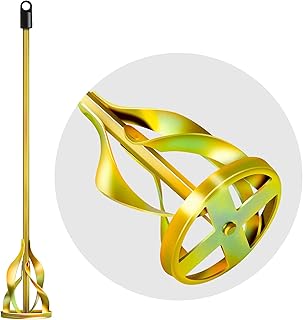
- Four-blade helix head with 2.76″ diameter
- Rust-proof steel with zinc plating; aims for uniform mixing
- Optimized for 1–5 gallon buckets; better efficiency than smaller heads
- Compatible with standard drills or impact drivers
- Best for paints, resins, epoxies, and slurries; avoid very heavy concretes
Best for practical, even color and texture in paints and coatings. Choose this if you handle 1–5 gallon jobs and want faster, more consistent results. Limitation: larger head may require more power for very thick mixes.
QEP 61205 Professional 24″ Long Mixing Paddle

- Very long 23-1/2″ blade; wide 5″ blade
- Designed to minimize air bubbles in mixtures
- Fits standard 3/8″ or 1/2″ drill chucks
- Works with corded drills only
Best for professionals or DIYers working with grout, thinset, or cement-like mixtures that benefit from a wide mixing blade. Choose this if you need a high-capacity paddle for large, low-viscosity mixes. Limitation: requires corded power and larger drills; not ideal for small, quick mixes.
MorningRo 2 Pcs Paint Mixer for Drill

- Two mixing heads: about 19.69″ and 21.26″ long
- Rust-resistant steel with zinc-plated finish
- Includes two 5-gallon bucket-ready stirrers
- Suitable for paint, mud, epoxy, resin, and concrete slurry
Best for versatility and value with two lengths for 5-gallon work. Choose this when you frequently switch between different bucket sizes and need durable, long-reach paddles. Limitation: longer tools may be heavier to maneuver in tight spaces.
Edward Tools Paint Mixer Drill Attachment

- Fast, Even Flow design for quick, consistent mixing
- Fits all 3/8″ hand drills and larger
- Easy-clean surfaces support reuse
Best for rapid development of uniform mixes in paints and epoxies. Choose this if you want a reliable, easy-to-clean option that fits common drill sizes. Limitation: designed for general use; may not handle very thick concrete mixes as effectively as heavier-duty models.
Buying Guide: Key Purchase Considerations
What should you consider before buying a mixing paddle for a drill?
- Bucket size and material: Align blade diameter and length with your typical batch (1–5 gallons is common). Larger paddles work best for thicker coatings and heavier materials.
- Drill compatibility: Check shaft size (commonly 1/4″ to 5/16″ hex) and chuck size (3/8″ or 1/2″). Corded vs. cordless compatibility matters for power and control.
- Material compatibility: Steel paddles with zinc plating resist rust and ease cleaning; some designs are optimized for paint, epoxy, resin, or grout.
- Blade design: Helix or multi-blade heads improve mixing efficiency; wider blades reduce air bubbles in cementitious mixes.
- Durability vs. ease of use: Long paddles offer reach but require more control; reinforced welds and rust resistance extend life in harsh mixes.
Frequently Asked Questions
- What mixing paddle to choose for small 1-gallon batches? – Look for a compact paddle with a 15–16 inch length and a 2–3 inch head suitable for 1–3 gallon batches.
- Can I use these with any drill? – Most are designed for standard drills or impact drivers; always verify chuck size and shank compatibility.
- Are longer paddles better for thick materials? – Longer paddles reach deeper into large buckets, but require more control, especially with viscous mixes.
- Do these affect paint color uniformity? – Yes, a well-designed mixer with a larger head or multiple blades improves color and texture consistency.
- Is a non-slip hex head important? – Yes, it helps prevent slipping during high-torque mixing and reduces wobble.
- When should I avoid a mixer? – For very thick aggregates or heavy concrete, dedicated heavy-duty mixers may perform better than standard drill attachments.