Best Miter Saw Finish Blades for Clean, Precise Wood Cuts
The best miter saw finish blade depends on your saw’s diameter and arbor, the material you cut, and how smooth the cut needs to be. The WEN BL1080 suits 10-inch saws needing an 80-tooth blade, while the Diablo D1280X is a strong option for fine crosscuts with a 12-inch saw. For an especially high tooth count, consider the 120-tooth 10-inch blade. Check your saw’s specifications before choosing.
| Blade | Best For | Key Detail |
|---|---|---|
| WEN BL1080 | 10-inch saws | 80 teeth, 5/8-inch arbor |
| Diablo D1280X | 12-inch fine crosscuts | 80 Hi-ATB teeth, 1-inch arbor |
| 120-Tooth 10-Inch Blade | Fine-finish cuts | 120 teeth, 5/8-inch arbor |
| OEM Home 12-Inch 80T 2-Pack | Buyers wanting two blades | 1-inch spindle, 4,800-RPM maximum |
| WEN BL1200 | 12-inch saws | 100 teeth, 1-inch arbor |
WEN BL1080 10-Inch 80-Tooth Blade

Best for: Woodworkers with a compatible 10-inch miter saw who want a fine-finish blade for both hardwoods and softwoods.
This carbide-tipped blade has 80 teeth, a 5/8-inch arbor, and a stated maximum rating of 6,000 RPM. Its 1/10-inch kerf is designed for clean, efficient cuts. The combination of a common 10-inch diameter and high tooth count makes it a practical choice for finish work when the saw’s arbor and speed specifications match.
Limitation: It is a 10-inch blade, so it is not the right choice for a 12-inch saw. Confirm the arbor and RPM requirements before installation.
Diablo D1280X 12-Inch 80-Tooth Blade

Best for: Buyers seeking a 12-inch blade for fine crosscuts in hardwoods and softwoods.
The D1280X uses 80 Hi-ATB teeth, a geometry intended to create smooth cuts with minimal tear-out. Its high-density carbide is described as engineered for the blade’s application. Choose this model if your saw takes a 12-inch blade and has a 1-inch arbor, and you prioritize crosscut finish quality.
Limitation: The listed arbor is 1 inch, so it may not fit a saw with a different arbor size. Check the saw manual rather than assuming compatibility.
10-Inch 120-Tooth Fine-Finish Blade
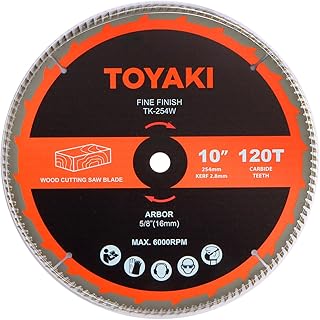
Best for: Buyers who want a high tooth count for fine-finish work with a compatible 10-inch saw.
This blade has 120 teeth and a 5/8-inch arbor. Its listed features describe it for wood and soft materials, with a tooth pattern intended to support clean, accurate cuts and reduce vibration. Compared with the 80-tooth 10-inch option, its higher tooth count makes it a candidate for buyers prioritizing a fine finish.
Limitation: The product information does not state a maximum RPM or tooth material. Verify operating limits and suitability for your material before use.
OEM Home 12-Inch 80-Tooth Two-Pack

Best for: Buyers who want two 12-inch blades and whose saw accepts a 1-inch spindle.
The listed specifications include 80 ATB carbide-tipped teeth, a 0.091-inch kerf, a 7-degree hook angle, and a maximum speed of 4,800 RPM. The product is described for cutting cork, hardwood, plywood, multilayer board, and MDF. Its vibration-reducing groove design and two-blade format may suit users who want a spare available.
Limitation: Do not exceed the stated 4,800-RPM maximum. Despite the product name’s reference to stainless steel, the features describe wood and wood-based materials; confirm intended use before cutting other materials.
WEN BL1200 12-Inch 100-Tooth Blade
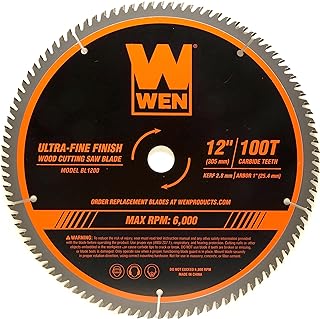
Best for: Owners of compatible 12-inch saws who want a high-tooth-count blade for hardwood and softwood.
The BL1200 is a carbide-tipped blade with 100 teeth, a 1-inch arbor, and a stated rating of up to 6,000 RPM. Its 1/10-inch kerf is designed for clean, efficient cuts. Choose it over an 80-tooth option if the 12-inch diameter and arbor match your saw and you prefer more teeth for finish work.
Limitation: It will not fit a 10-inch saw, and the saw’s permitted speed and arbor must match the blade’s specifications.
Buying Guide: How to Choose a Miter Saw Finish Blade
Does the blade diameter match your saw?
Start with the diameter required by the saw, commonly 10 or 12 inches for the products here. A blade with the wrong diameter is not an appropriate substitute. Check the owner’s manual and the existing blade before buying.
Which arbor size and RPM rating should you check?
Match the blade’s arbor to the saw’s spindle. The products listed include 5/8-inch and 1-inch arbors. Also compare the blade’s maximum RPM with the saw’s operating speed. Never exceed the blade’s stated limit; the OEM Home two-pack, for example, lists a 4,800-RPM maximum.
How many teeth do you need for a smooth finish?
Higher tooth counts are often chosen for fine cuts, but tooth count alone does not establish compatibility or guarantee a particular result. Among these options, the 10-inch blade has 120 teeth, the WEN 12-inch model has 100, and several blades have 80. Select a blade intended for the material and cut you plan to make.
What do kerf and tooth geometry tell you?
Kerf is the width of the cut. A thinner kerf can remove less material, but it must still be suitable for the saw and cutting task. ATB and Hi-ATB tooth designs are identified on some options as features for clean crosscuts and reduced tear-out. Check the product specifications for the individual blade rather than assuming all finish blades share the same design.
Is a finish blade suitable for every material?
No. These products are primarily described for wood, softwoods, hardwoods, and—in one listing—wood-based panels. Do not infer suitability for metal or other materials from a broad product title. Confirm the blade’s intended material and follow the saw manufacturer’s safety instructions.
Frequently Asked Questions
What is a miter saw finish blade used for?
It is used to make smooth crosscuts in materials named by the blade manufacturer, such as hardwood or softwood. The right choice depends on saw compatibility and the intended cut.
Is a 100-tooth blade always better than an 80-tooth blade?
No. Tooth count is one selection factor, not a guarantee of better results. Match blade diameter, arbor, speed rating, and material first.
Can I put a 12-inch blade on a 10-inch miter saw?
No. Use the blade diameter specified for the saw. A 12-inch blade is not a replacement for a 10-inch blade.
What should I check before installing a finish blade?
Confirm the diameter, arbor size, maximum RPM, and approved cutting material. Follow the saw’s manual and installation instructions.