Best Metal Pipe Bender Tools for Tubing and Sheet Metal
The best metal pipe bender depends on the tube’s outside diameter, material, wall thickness, and required bend angle. VEVOR is best for larger round tubing and multiple die sizes; the syizyen and DOMINOX tools suit smaller tubing; Beaiguna is designed for forward and reverse bends; and MAXPOWER is for sheet-metal ductwork rather than ordinary round-tube bending. Check the tool’s stated range against your material before choosing.
| Tool | Best suited for | Key range or feature |
|---|---|---|
| VEVOR Manual Pipe Tube Bender | Larger round tubing | 3/8–1 inch; seven dies |
| syizyen 3-in-1 Tube Bender | Small-diameter tubing | 1/4, 5/16, and 3/8 inch; up to 180° |
| DOMINOX 3-in-1 Tube Bender | Small tubing with specified thin walls | 1/4, 3/8, and 1/2 inch O.D. |
| Beaiguna 15-piece Copper Pipe Bender | HVAC work and tight spaces | Seven heads; forward and reverse bends |
| MAXPOWER Hand Seamers and Crimper | Sheet-metal pipe and ductwork | Six-inch jaw span; five-blade crimper |
VEVOR Manual Pipe Tube Bender

This VEVOR tool is best for users bending larger round metal tubing across several sizes. It accepts 3/8- to 1-inch-diameter round stock and includes seven steel dies in those listed sizes. The product states a bending capacity for iron pipe under 0.08 inch (2 mm) thick, and its listed bend radii range from 50 to 113 mm.
The long ergonomic handle and portable design make it a practical choice for repair-shop tasks where manual operation is suitable. Choose it if your work needs multiple die sizes rather than a compact tool for only small tubing. Limitation: It is specified for round stock, and its stated iron-pipe thickness limit may rule it out for thicker material.
syizyen 3-in-1 Manual Tube Bender

This tool is best for small tubing and users who need bends up to 180 degrees. Its three sizes are 1/4, 5/16, and 3/8 inch outside diameter. The listed materials include copper, aluminum, brass, and thin stainless steel. Its aluminum frame, ergonomic bending hook, and long knurled non-slip handle are intended to provide leverage and grip during manual bending.
Choose this model if your tubing matches one of its three sizes and you need a broad bending-angle range. It is more specialized for smaller tubing than the VEVOR model. Limitation: The listed sizes stop at 3/8 inch, so it is not the right pick for larger-diameter pipe.
DOMINOX 3-in-1 Tube Bender

The DOMINOX bender is best for small-diameter tubing when the exact outside diameter and wall thickness are known. It is designed for 1/4-, 3/8-, and 1/2-inch O.D. tubing with stated wall thicknesses of 0.5 to 1.2 mm. Listed materials include copper, aluminum, thin-walled iron, and thin-walled stainless steel. Its long handle is intended to distribute force and help limit flattening during a bend.
Check actual outside diameter before buying: the listing specifically warns that 1/2-inch plumbing copper tube, which measures about 5/8 inch O.D., is not compatible. Limitation: Its size range and wall-thickness specification are restrictive; nominal pipe size alone is not enough to confirm fit.
Beaiguna 15-Piece Copper Pipe Bender
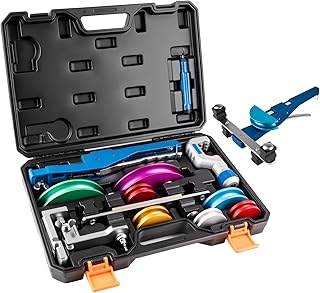
Beaiguna is best for HVAC users who need to make forward or reverse bends in tighter work areas. The kit includes seven heads and is described for 1/4- to 7/8-inch O.D. pipes. The listing names copper, aluminum, thin-walled stainless steel, and PVC as suitable materials. A ratcheting mechanism, extended handle, reverse adapters, and rigid storage case are among its stated features.
Choose this tool if changing bending direction and organizing multiple heads matter to your work. The listed maximum bend angle is 90 degrees, making it less suitable when you need a 180-degree bend. Limitation: Confirm that your specific tubing material and diameter are covered by the kit before use.
MAXPOWER Sheet Metal Seamers and Crimper

This MAXPOWER tool is best for sheet-metal ductwork, roofing, downspouts, and similar forming tasks—not for bending ordinary round tubing. It combines hand seamers with a five-blade pipe crimper. The listing specifies a six-inch jaw span for bending, stitching, and flattening sheet metal, plus a crimper throat depth of up to 1.6 inches. Its construction is described as alloy steel.
Choose it if “pipe” means sheet-metal pipe or duct that needs crimping or seam work. Limitation: Its features describe sheet-metal forming and crimping, not tube bending with interchangeable round-tube dies.
Buying Guide: How to Choose a Metal Pipe Bender
What size tubing does the tool accept?
Compare the tool’s stated range with the tubing’s measured outside diameter. Do not rely only on a nominal plumbing size: the DOMINOX listing warns that 1/2-inch plumbing copper tube has an actual outside diameter of about 5/8 inch. A mismatch can prevent the tube from fitting the bender correctly.
Which material and wall thickness are you bending?
Product specifications often distinguish soft metals from thin-walled steel. Check the listed materials and thickness limits before selecting a tool. For example, VEVOR states a limit for iron pipe under 2 mm thick, while DOMINOX specifies a 0.5–1.2 mm wall range. Do not assume a tool handles every metal or thickness.
What bend angle and work access do you need?
For angles up to 180 degrees, the syizyen and DOMINOX listings describe that range. Beaiguna is listed for bends up to 90 degrees and includes reverse adapters for forward and reverse bending. Consider handle length, ratcheting action, and the space around the workpiece when choosing a manual tool.
Is it a tube bender or a sheet-metal tool?
Tube benders shape round tubing using size-matched forms or heads. Hand seamers and crimpers shape sheet metal, including duct sections. MAXPOWER belongs to the second category, so it should not be treated as a substitute for a round-tube bender.
Frequently Asked Questions
How do I choose the right pipe bender size?
Measure the tubing’s outside diameter and match it to the tool’s stated size range. Check wall thickness and material as well.
Can these tools bend steel pipe?
Some listings specify thin steel or thin-walled iron. VEVOR lists iron pipe under 2 mm thick; other tools have their own material limits. Verify the product’s specifications for your tube.
Does a 1/2-inch bender fit 1/2-inch plumbing copper?
Not necessarily. The DOMINOX listing says 1/2-inch plumbing copper tube is about 5/8 inch O.D. and is not compatible with its 1/2-inch O.D. setting.
Which listed tool is for sheet-metal ductwork?
MAXPOWER is described for sheet-metal bending, seaming, flattening, and crimping. It is not presented as a standard round-tubing bender.