Best Laser Transit for Grading: Five Options for Site Leveling
A rotary laser level with a receiver is generally the most useful type of laser transit for grading because it provides a level reference across a work area that can be read outdoors. The Lipril kit is best suited to accuracy-focused grading, while VEVOR offers a ready-to-use kit for smaller sites. H-YEEU emphasizes range and jobsite protection. The Huepar and KEZERS models are line lasers, so they are better suited to layout and renovation tasks than broad outdoor grading.
| Product | Best suited for | Notable feature |
|---|---|---|
| Lipril 206HR | Accuracy-focused grading | ±1/16 inch at 100 feet |
| VEVOR Rotary Laser Kit | Small jobsites and remodels | Receiver, tripod, and grade rod included |
| H-YEEU Rotary Laser Kit | Wide work areas | 500-meter stated range with receiver |
| Huepar W04CG | Indoor layout and alignment | Four 360-degree green laser planes |
| KEZERS Laser Level Set | Renovation and multi-purpose layout | Receiver, tripod, and grade rod included |
Lipril 206HR Rotary Laser Level Kit
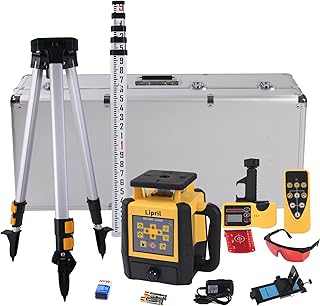
Best for: Buyers prioritizing stated accuracy and durability for grading, foundation layout, or concrete form work. The manufacturer lists accuracy of ±1/16 inch at 100 feet and a working range of up to 2,296 feet. Automatic self-leveling supplies a reference line on uneven terrain.
The kit includes a 5-foot tripod and grade rod. Its 4,000mAh rechargeable Ni-MH battery is listed for 12 hours of operation, and the field-replaceable battery system can also use the included dry-battery adapter, though batteries for that adapter are not included. The product is described as IP66 and dust-tight and water-resistant.
Limitation: The listed operating time is finite, so plan charging or battery changes for extended field shifts.
VEVOR Rotary Laser Level Kit

Best for: Small jobsites and remodels where an included receiver and setup accessories are useful. VEVOR lists a 984-foot working distance with receiver and includes a tripod, grade rod, remote control, receiver, and tool case.
The 360-degree rotating laser offers five speed settings and multiple scan angles. It self-levels within ±5 degrees and also has a manual mode. The rechargeable NiMH battery is listed for 8–12 hours per charge. Laser glasses are included to help visibility in bright conditions.
Limitation: Its stated range is shorter than the Lipril and H-YEEU listings, so compare the range with the size of the grading area before choosing.
H-YEEU 360-Degree Rotary Laser Kit

Best for: Buyers who want a long stated working distance and a kit intended for construction and building work. The product lists a 500-meter working distance when used with its receiver, automatic alignment, 360-degree rotation, and a 5-degree auto-alignment range.
It includes a 1.65-meter tripod, 5-meter grade rod, receiver, and remote. The manufacturer describes the housing as IP54 dustproof and water-resistant and says its design can withstand drops from 3.3 feet onto concrete.
Limitation: The listed range depends on using the receiver. Confirm the included components and operating instructions for the specific grading setup.
Huepar W04CG 4D Laser Level

Best for: Indoor layout work, remodeling, and buyers who want remote-controlled line positioning. The Huepar produces four 360-degree planes of green laser light and has a motorized base with three speed modes. Its app or included remote can control it from up to 65 feet, according to the listing.
This model differs from a rotary transit: it projects cross-line planes rather than a rotating reference beam paired with a grading receiver. It may suit indoor alignment tasks, but the provided product details do not list an outdoor grading range or receiver.
Limitation: Choose a rotary laser with a receiver instead if you need to transfer elevations across a large outdoor grading area.
KEZERS 4 x 360 Laser Level Set

Best for: Buyers seeking a broad accessory set for home renovation and layout tasks. It includes a receiver, 60-inch tripod, 9-foot grade rod, two batteries, remote control, and a touch-screen laser level with four 360-degree planes.
The listing describes horizontal and vertical lines, a manual mode, self-leveling mode, and pulse mode. A lifting base can raise the floor laser line over obstacles between 1 and 3.54 inches high. Those features support floor, ceiling, and square-layout work.
Limitation: The provided details do not state an outdoor working range or grading accuracy. For elevation control over a large site, compare it with the rotary options.
Buying Guide: Choosing a Laser Transit for Grading
Should you choose a rotary laser or a line laser?
For grading, a rotary laser with a receiver is usually the more direct fit: the receiver detects the reference beam and helps locate the target elevation at different points around a site. A cross-line laser is often designed for indoor alignment. Check the product listing for an included receiver and a stated outdoor working range before using a model for site grading.
How much range and accuracy do you need?
Match the stated range to the jobsite, and note whether the manufacturer specifies that range with a receiver. Accuracy matters when setting elevations for foundations, forms, or drainage. Compare figures on the same basis, such as accuracy at 100 feet, rather than assuming that a longer range means greater precision.
Which accessories and protections matter?
A receiver, grade rod, and tripod can simplify setup and elevation checks. For longer shifts, consider battery life and whether the battery can be swapped or recharged. Dust and water protection can also matter on active sites; compare the listed IP rating, but follow the manufacturer’s care and operating instructions.
Frequently Asked Questions
What type of laser level is best for grading?
A rotary laser level with a compatible receiver is generally the practical choice for transferring a level reference across an outdoor work area.
Why is a receiver useful for grading?
A receiver detects the laser reference so an operator can locate the beam elevation on a grade rod, including where the beam is difficult to see directly.
Does a longer working range guarantee better accuracy?
No. Range describes how far the tool is specified to work, while accuracy describes how close its reference is to level. Compare both specifications.
Can a 360-degree line laser replace a rotary laser for outdoor grading?
Not necessarily. A 360-degree line laser projects planes, but outdoor grading suitability depends on its receiver support, range, and stated accuracy.