Best Joint Cutters for Concrete That Deliver Clean, Precise Grooves
Answering the common buyer question: the best joint cutters for concrete are tools designed to create clean, durable control joints with minimal chipping. This guide focuses on models that balance blade quality, ease of use, and compatibility with standard handles. The top picks suit professional masons, DIY homeowners, and contractors who need repeatable, straight grooves. Each product is evaluated for job size, groove width, and maneuverability to help you choose the right tool for moderate to large concrete projects.
Summary of selected products:
| Product | Groove Type | Best For | Limitations |
|---|---|---|---|
| Kraft Tools CC026 8″x8″ Stainless | 1/2″ radius threaded | Grooving across wide slabs | Includes threaded handle socket |
| Kraft Tool CF409 2″x6″ Stainless | Groover with 1/2″ radius | Precise curved control joints | Long blade profile requires stability |
| MARSHALLTOWN QLT Mini ROCK-IT | 180° adjustable angle | Flexible handle positioning | Angle adapter accessory, not standalone |
| Kraft Tool CC006W-125 24″ Groover | Straight control joint | Stability on wide joints | 12–14 inch class handle is needed |
| Bon 22-838 Geno Saw Cut Groover | 1″ x 3/32″ groove | Simulated saw-cut appearance | Narrow groove, cosmetic focus |
Kraft Tools CC026 8″ x 8″ Stainless Walking Seamer

This walking seamer offers an 8″ by 8″ footprint with a 1/2″ radius and threaded handle socket. Best for wide, consistent grooves across larger slabs where a steady, uniform channel is needed. Suitable for contractors who require a robust, simple-to-use groover that resists binding under pressure. Caution: ensure the handle is securely fastened to prevent wobble during operation.
Kraft Tool CF409 2″x6″ Stainless Curb Jointer

This 2″ by 6″ curb jointer uses a stainless blade and a 2″ long groover bit. It creates a 3/4″ wide, 1/2″ deep groove with a 1/2″ radius to reduce chipping. It’s ideal for precision control joints where a tighter, cleaner appearance is required. Best for detailed joints in smaller sections or edging projects. Limitations: the tool extends about 3″ on each side of the groove, which may complicate alignment on very tight slabs.
MARSHALLTOWN QLT Mini Rock-It Angle Adapter

Designed to let you place a handle at any position within a 180° sweep, this angle adapter connects push-button handles to edgers, groovers, Fresnos, and bull floats. Best for users who need flexible reach after adjusting joints in awkward spaces. Choose this if you frequently re-angle handles to maintain straight grooves. Caution: it’s an adapter accessory—requires compatible handles for full use.
Kraft Tool Kraft CC006W-125 24″ Straight Arrow Groover

This 24″ by 4″ straight arrow grubber uses a high-grade aluminum body with a 1-1/4″ deep bit. It delivers stable, straight grooves in larger joints with a broad top surface for balance. Best for professionals handling long, uninterrupted control joints. Limitations: longer length requires more space to maneuver and can be less convenient in tight corners.
Bon Geno Saw Cut Walking Groover
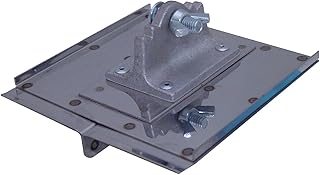
Bon’s Geno Saw Cut Groover creates a simulated saw-cut groove with a 1″ by 3/32″ bit, producing clean, square grooves that mimic true saw cuts. The product is best for projects aiming for a traditional saw-cut look, ideal for decorative or historic restoration work. Limitation: the groove is relatively narrow, which may not suit broader control joints on larger slabs.
Buying Guide
- Groove width and depth: Match the groove size to project needs—narrow cosmetic grooves vs. wider structural joints.
- Blade material and radius: Stainless blades reduce wear; radius helps limit chipping at the groove edges.
- Handle system: Fixed handles offer stability; adjustable/angled handles improve access in confined spaces.
- Length and reach: Longer tools suit large slabs; shorter tools excel in tight corners.
- Footprint and balance: A wider top or base improves control; ensure compatibility with your current handle hardware.
Frequently Asked Questions
- What is the difference between a curb jointer and a control joint groover?
– A curb jointer is designed for smoother, curved joints near edges; a control joint groover makes deeper, straighter lines through slabs. - Can I use these tools on fresh or set concrete?
– Most are intended for set or cured concrete to ensure clean grooves; check individual product specs for early-entry suitability. - Which tool is best for large slabs?
– Tools with longer blades and wider top surfaces provide stability on large slabs, such as the 24″ straight groover. - Do these tools require special handles or attachments?
– Some models include handles or adapters; others are compatible with standard push-button handles or custom setups. - Is a saw-cut style groove preferable for all projects?
– Saw-cut style grooves look authentic in certain designs; for structural joints, deeper groovers may perform better.