Best Japanese Timber Framing Chisels for Heavy Joinery and Mortise Work
For heavy timber framing, choose a chisel built for striking and deep mortises, such as the 24mm KAKURI Timber Framing Chisel. The 42mm KAKURI timber chisel is better for wider cuts and rough finishing, while the SUIZAN and KAKURI bench chisels suit more general woodworking. The GREBSTK set is a broader, non-Japanese option for buyers who want several common sizes rather than a dedicated framing tool.
| Product | Best suited for | Type |
|---|---|---|
| KAKURI 24mm Timber Framing Chisel | Deep mortises and heavy cutting | Heavy-duty striking chisel |
| KAKURI 42mm Timber Framing Chisel | Wide timber cuts and rough finishing | Semi-striking chisel |
| SUIZAN 24mm Wood Chisel | Precise general-purpose work | Oire Nomi bench chisel |
| KAKURI 42mm Oire Nomi | Wide cuts and general woodworking | Bench chisel |
| GREBSTK 4-Piece Set | Multiple everyday chisel sizes | General-purpose set |
KAKURI 24mm Heavy-Duty Timber Framing Chisel

This 24mm KAKURI is designed specifically for timber framing, joinery, deep mortises, and heavy wood removal. Its thick blade is larger and stronger than a standard Oire Nomi bench chisel, and the product is also described as a Tataki Nomi, or striking chisel.
The blade uses laminated Japanese White Paper Steel #2 and soft iron. The maker describes this construction as balancing edge sharpness, sharpening ease, and blade strength. Its Japanese red oak handle is designed to take mallet strikes.
- Best for: Buyers who need a dedicated, compact-width chisel for heavy framing and deep mortises.
- Why it stands out: Its stated striking-chisel design and thick blade directly match demanding timber work.
- Consider: At 24mm, it is narrower than the 42mm options and may not suit wide cuts as efficiently.
KAKURI 42mm Semi-Striking Timber Chisel

This 42mm chisel is made for large timbers, timber framing, joinery, and rough shaping. KAKURI describes it as a Han Tataki Nomi, or semi-striking chisel. It is relatively slim among large Japanese chisels, which the product description positions as a balance for handling during larger jobs.
Like the 24mm framing model, it has a laminated White Paper Steel #2 blade and a Japanese red oak handle intended for demanding work.
- Best for: Timber workers who want a wider edge for broad cuts and rough finishing.
- Why it stands out: It combines a large 42mm width with a framing-focused, semi-striking design.
- Consider: Its wider blade is less suited than a narrow chisel to confined or small-scale cuts.
SUIZAN 24mm Japanese Bench Chisel

The SUIZAN 24mm Oire Nomi is a general-purpose Japanese bench chisel for precise cutting, shaping, mortising, and smoothing. Its product information describes a sharp superalloy blade, hardened using traditional techniques and sharpened by craftsmen. It is manufactured in Japan.
- Best for: Buyers who want a Japanese-made 24mm chisel for mixed joinery and detail work.
- Why it stands out: The listed uses extend beyond mortising to shaping and smoothing.
- Consider: It is identified as a bench chisel, not a heavy-duty timber-framing or striking chisel.
KAKURI 42mm Oire Nomi Bench Chisel
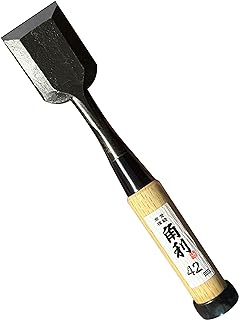
This wide KAKURI Oire Nomi has a listed blade width of 1.65 inches, approximately 42mm. The product description identifies it for architecture, furniture, and DIY woodworking, and says its sturdy blade can be struck with a hammer. It also describes the blade as chamfered to reduce resistance during cutting.
- Best for: Woodworkers needing a wide Japanese chisel for varied woodworking, including larger cuts.
- Why it stands out: Its broad blade and strike-capable construction offer flexibility beyond fine detail work.
- Consider: It is a general Oire Nomi rather than a model specifically identified as a timber-framing chisel.
GREBSTK Four-Piece General Wood Chisel Set

This set includes 1/4-, 1/2-, 3/4-, and 1-inch chisels with chromium-vanadium steel blades, beech handles, and safety caps. The product information lists a factory-honed 25-degree bevel and uses including mortising, paring, and trimming.
- Best for: Buyers who value a range of common widths for everyday woodworking tasks.
- Why it stands out: Four sizes cover varied cuts, and the listed features include handles and safety caps.
- Consider: This is a general-purpose set, not a Japanese-made timber-framing chisel.
Buying Guide: How To Choose A Japanese Timber Framing Chisel
Should you choose a dedicated framing chisel or a bench chisel?
For repeated mallet-driven cuts in large timbers, prioritize a tool explicitly described as a timber-framing, Tataki Nomi, or semi-striking chisel. Bench chisels can handle general joinery and other woodworking, but their product descriptions may not specify the same heavy-duty role. Match the chisel type to the force and scale of the work.
What width is right for your work?
A 24mm blade is a practical choice when the cut needs a narrower edge or access is limited. A 42mm blade removes material across a wider area and can help with broad cuts, but its size may be awkward in confined work. Consider the mortise or joint dimensions before choosing a width.
What should you know about blade materials?
The two KAKURI framing chisels list laminated White Paper Steel #2 and soft iron. Their descriptions emphasize sharpness, strength, and ease of sharpening. The SUIZAN lists a Japanese superalloy blade, while the GREBSTK set lists chromium-vanadium steel. Compare the stated materials and sharpening needs against your own maintenance preferences.
Does handle and tool setup matter?
For striking work, the KAKURI framing models have Japanese red oak handles described as designed for mallet blows. The GREBSTK set instead emphasizes ergonomic beech handles and safety caps. Check the product’s stated use and handle features; do not assume every bench chisel is intended for heavy striking.
Frequently Asked Questions
What is a timber-framing chisel used for?
It is used for heavy wood removal, chopping mortises, shaping large timbers, and timber-frame joinery. The listed KAKURI framing chisels are specifically described for these tasks.
Is a 24mm or 42mm chisel better?
Choose 24mm for narrower cuts and 42mm for wider cuts and broad material removal. The best width depends on the joint dimensions and available working space.
Can a bench chisel be used for timber framing?
A bench chisel can be used for woodworking and mortising, but it may not be designed for heavy framing strikes. Check whether the specific product is identified as a striking or timber-framing chisel.
Are all the listed products Japanese-made?
No. The KAKURI and SUIZAN products are described as made in Japan. The GREBSTK set is not identified as Japanese-made in the supplied product information.
Which option offers multiple blade widths?
The GREBSTK set includes four widths: 1/4, 1/2, 3/4, and 1 inch. It is a general wood chisel set rather than a dedicated Japanese framing tool.