Best Heavy Duty Bench Vise for Tough Jobs
Looking for a bench vise that can handle demanding workshop tasks? This guide spotlights five heavy duty options suited for pros and serious DIYers. Each pick is evaluated for clamp force, jaw versatility, and ease of use. The top buyers are those needing reliable stability, durable construction, and flexible jaws for pipes, rounds, and various shapes. The table below summarizes the five featured vises to help you compare at a glance.
| Product | Jaw Width | Jaw Opening | Throat Depth | Clamp Force |
|---|---|---|---|---|
| Forward CR80A 8″ Bench Vise | 8″ (200 mm) | 9″ (229 mm) | 4.1″ (104 mm) | 12,000 lbs |
| Wilton Reversible Bench Vise 8″ | 8″ | 9.25″ / 14.5″ (reversed) | 4.75″ | — |
| VEVOR Heavy Duty 6.5″ Vise | 6.5″ | 5″ | ~3.5″ | ~5,520 lbs |
| Forward DT08125A 5″ Vise | 5″ | 5″ | 2.6″ | ≥5,500 lbs |
| Wilton 550P 5-1/2″ Vise | 5.5″ | 5″ | 2.75″ | — |
Each product below is chosen for different user needs—whether you require maximum jaw versatility, pipe gripping, or robust all-around performance. Use this guide to identify which vise best matches your typical workloads, shop size, and material types.
Forward CR80A 8 Inch Bench Vise

The Forward CR80A combines a premium ductile iron body with a large 8″ jaw width and a 9″ opening. It includes two jaw sets: replaceable serrated top jaws and built-in pipe jaws, plus built-in pipe range from 1/2″ to 3 1/2″. This vise supports heavy workshop tasks and garage work. Best for: professionals needing a strong, durable vise with pipe-jaw capability for metalworking and fabrication projects.
Best for users who require a stable, high-load clamp and versatility in jaw configurations. A limitation is the relatively large size, which may demand extra bench space in compact shops.
Wilton Reversible Bench Vise, 8″ (Model 4800R)

Wilton’s 8″ reversible vise features a 9-1/4″ jaw opening in normal position and 14-1/2″ when reversed, with built-in pipe jaws to handle diverse pipe sizes. The 360° swivel base and dual lockdowns offer flexible positioning. Best for: shops that frequently switch between standard clamping and pipe work, and need quick reorientation for welding or assembly tasks.
Consideration: the reversible design adds complexity and may require extra setup time for precise alignment during multi-angle work.
VEVOR Heavy Duty 6.5″ Bench Vise

VEVOR’s 6.5″ vise uses ductile cast iron for durability and offers pipe jaws and V-jaws to accommodate round pipes and irregular shapes. With a 3D-rotating 360° base, you can position workpieces precisely for welding or cutting. Best for: metalworkers who need strong clamping on varied shapes and reliable rotation for complex tasks.
Limitation: rated clamping force is strong but may be lower than the largest 8″ models for the most demanding heavy metalwork tasks.
VEVOR Bench Vise, 6-Inch, With Anvil

This VEVOR model provides a 6″ jaw width, a 5″ opening, and a 3.5″ throat depth. It includes a 2.9″ x 3″ anvil and a sturdy ductile iron build, with set of nuts, screws, and magnetic jaw pads for easier installation. Best for: hobbyists and pros needing a complete kit with a built-in anvil and practical gravity of space for installation. Caution: ensure the mounting surface is strong enough to handle the full clamping force and vibration during heavy work.
Forward DT08125A 5″ Heavy Duty Bench Vise
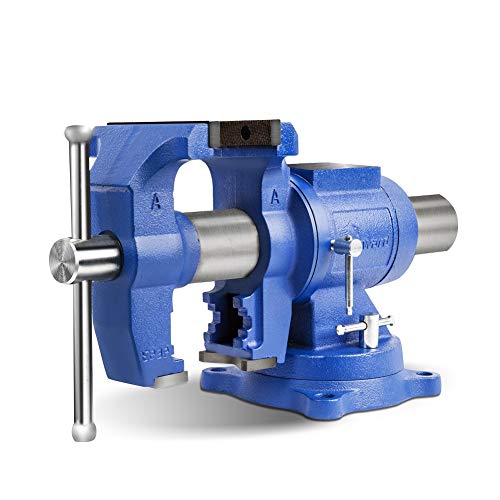
The 5″ Forward vise uses ductile iron with a 60,000 PSI rating and a 5″ jaw width and opening. It features three jaw sets: replaceable top jaws with microgroove, built-in pipe jaws, and V-jaws for versatile gripping. Best for: compact shops needing a robust, multi-jaw setup in a smaller footprint. Caution: smaller jaw width may limit handling of larger stock.
Forward DT150B 6″ Heavy Duty Vise
Forward DT150B offers a 6″ jaw width with a 5″ opening and a 2 5/8″ throat, built on high-strength cast iron and ductile iron for durable performance. It includes three jaw configurations for secure gripping. Best for: users who need stronger clamping for medium to heavy fabrication tasks. Limitation: heavier weight may require a sturdier bench and more mounting hardware.
Buying Guide: Key Purchase Considerations
What clamp force do you need? Choose a vise with a clamping force that matches your typical material and task. Pipe jaws and V-jaws expand versatility for metalworking. A 360° swivel base improves positioning for welding and drilling. Consider ductile iron for strength and long-term durability, and examine jaw options (top jaws, pipe jaws, V-jaws) to fit your workpieces.
What size matters most? Jaw width determines what you can clamp comfortably. Larger 8″ vises handle bigger stock and heavier tasks but require more bench space. For tight shops, 5″ to 6″ vises fit better while still delivering solid performance.
Is a built-in anvil valuable to you? Some models include a small anvil for light hammering and shaping. If your workflow requires frequent shaping, this feature can save time, otherwise it may be optional.
What about mounting and maintenance? Verify the base is stable and the mounting bolts are included or readily available. Enclosed spindles and lubricants help keep the vise smooth and last longer in dusty environments.
FAQ
- What is the best heavy duty bench vise for pipe work?
– Vises with built-in pipe jaws and a strong clamping force, like the Forward CR80A or Wilton 4800R, are well-suited for pipe work when versatility and grip are crucial. - Should I choose a reversible vise?
– Reversible vises offer flexibility for different angles and pipe access but may require extra setup time for precise alignment. Consider your typical workflow. - Is a larger jaw width always better?
– Not always. A larger jaw width supports bigger stock but takes more bench space and may be overkill for small parts. Match jaw width to common workpieces. - Why pick a vise with multiple jaw sets?
– Multiple jaw options (top jaws, pipe jaws, V-jaws) expand grip variety, enabling secure handling of diverse materials without swapping setups often. - Do I need an anvil?
– An anvil is useful for light hammering and shaping. If your tasks rarely involve metal shaping, you can prioritize other features like jaw versatility and base rotation. - What maintenance helps extend life?
– Regular lubrication, clean contact surfaces, and checking fasteners keep operation smooth. Enclosed spindles protect lubricants from contaminants.