Best Fine-Tooth Miter Saw Blades for Smooth Wood Cuts
The best fine-tooth miter saw blade is one that matches your saw’s diameter, arbor, and maximum RPM while providing enough teeth for the finish you need. The WEN BL1080 is a strong fit for buyers seeking an 80-tooth 10-inch blade; the Diablo D1060X suits 10-inch wood-cutting projects where a 60-tooth blade is preferred; and the DEWALT 100-tooth blade is an option for compatible 12-inch saws. The selections below compare tooth count, dimensions, and listed features.
| Blade | Best For | Key Detail |
|---|---|---|
| WEN BL1080 | Fine cuts with a 10-inch blade | 80 teeth; 5/8-inch arbor |
| Diablo D1060X | 10-inch wood cutting | 60 Hi-ATB teeth |
| DEWALT DWA112100 | Fine cuts with a 12-inch blade | 100 teeth |
| TOYAKI 10-Inch 120-Tooth | Very high tooth count | 5/8-inch arbor |
| WEN BL1280 | 12-inch hard- and softwood work | 80 teeth; 1-inch arbor |
WEN BL1080 10-Inch 80-Tooth Blade
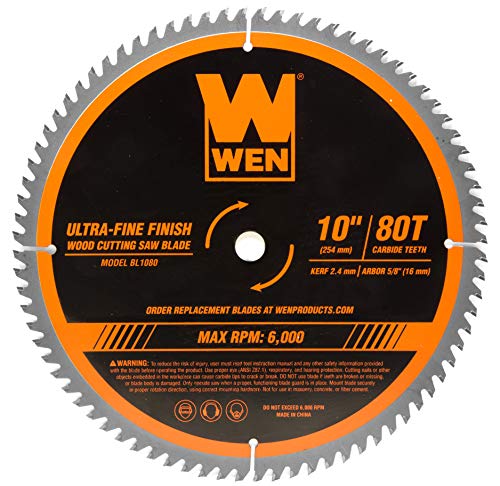
The WEN BL1080 is best for woodworkers with a compatible 10-inch saw who want an 80-tooth blade for fine-finish work. Its listed features include a 5/8-inch arbor, a maximum rating of up to 6,000 RPM, and a thin 1/10-inch kerf. WEN describes it for cutting hard and softwoods.
Choose this blade if its dimensions and speed rating match your saw and you want a higher tooth count than a general-purpose blade may offer. The thin kerf is designed for clean, efficient cuts. Its limitation is that it is a 10-inch blade with a 5/8-inch arbor, so it is not a fit for saws requiring different dimensions.
Diablo D1060X 10-Inch Fine-Finish Blade

The Diablo D1060X is best for buyers seeking a 10-inch blade with 60 Hi-ATB teeth for wood cutting. Its listed specifications include a 5/8-inch arbor and a .098-inch kerf. Diablo also describes a shock-resistant design intended to reinforce the carbide tips for demanding jobs.
Choose this option if you want a fine-finish blade with fewer teeth than the 80- or 120-tooth choices in this list. The product information does not state a maximum RPM, so check the blade packaging or manufacturer details before use and confirm that it suits your saw. Its 60-tooth count may not match buyers specifically seeking the highest tooth count available here.
DEWALT DWA112100 12-Inch 100-Tooth Blade

The DEWALT DWA112100 is best for users whose saw takes a 12-inch blade and who want a 100-tooth fine-finish option. Listed features include carbide teeth, a body-slot design intended to reduce vibration, and tooth geometry designed for increased accuracy. The product description also states that it is designed for improved finish quality.
Choose this blade if your priority is a high tooth count in a 12-inch format. Verify the arbor size and maximum RPM against your saw before buying, as those specifications are not included in the supplied product features. This blade is not the right choice for a 10-inch saw.
TOYAKI 10-Inch 120-Tooth Blade
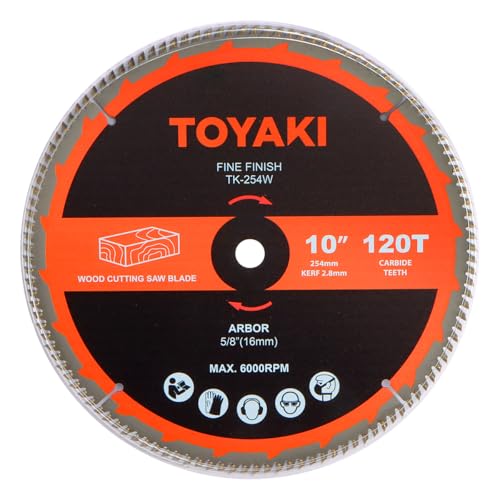
This TOYAKI blade is best for buyers looking for a 10-inch, 120-tooth blade for wood and other soft materials. It has a listed 5/8-inch arbor, and the product description says its tooth pattern is designed for clean, accurate cuts while reducing vibration. Its high tooth count makes it a distinct option for shoppers comparing fine-finish blades.
Choose it if your saw accepts a 10-inch blade with a 5/8-inch arbor and you want more teeth than the other listed 10-inch options. The stated cutting use is wood and soft materials; the product information does not establish suitability for metal or other hard materials. Confirm the maximum RPM before installation.
WEN BL1280 12-Inch 80-Tooth Blade
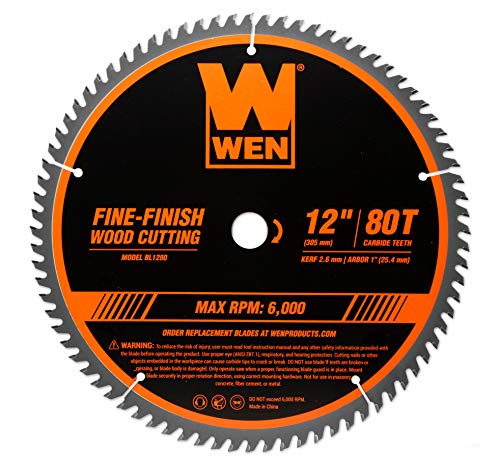
The WEN BL1280 is best for owners of compatible 12-inch saws who want an 80-tooth blade for hard- or softwood. It has a 1-inch arbor, a listed rating of up to 6,000 RPM, and a 1/10-inch kerf. These specifications make it a useful comparison for buyers who want a 12-inch option with fewer teeth than the DEWALT 100-tooth blade.
Choose this blade if your saw matches its 12-inch diameter, 1-inch arbor, and RPM rating. The main limitation is the arbor size: a saw requiring a different arbor will need a correctly specified alternative.
Buying Guide: How to Choose a Fine-Tooth Miter Saw Blade
Which blade diameter fits your saw?
Match the blade diameter to the size specified by your miter saw manufacturer. A 10-inch blade and a 12-inch blade are not interchangeable simply because both are intended for woodworking. Check the saw’s manual or existing blade before choosing.
How many teeth do you need?
Tooth count is one useful comparison point for finish work. The products here range from 60 to 120 teeth. Higher counts can be attractive when a smooth finish is the priority, but tooth count alone does not determine cut quality. Consider the blade’s stated use, tooth design, material, and your saw’s requirements.
Why check the arbor and RPM?
The arbor is the hole at the center of the blade. It must match the saw’s arbor specification, and any permitted adapter must follow the saw and blade manufacturers’ instructions. The blade’s maximum RPM must also meet or exceed the saw’s operating speed. Do not assume an unlisted specification.
Does kerf matter?
Kerf is the width of material removed by the blade. A thinner kerf can reduce the amount of wood removed, but the blade must still be appropriate for the saw and the intended work. Compare stated kerf dimensions where available; not every product listing provides one.
Frequently Asked Questions
Is a higher tooth count always better for a miter saw?
No. A higher count is one factor to compare for fine-finish cutting, but the correct blade also depends on saw compatibility, tooth design, and the material being cut.
Can I use a 10-inch blade on a 12-inch miter saw?
Do not assume that a smaller blade is acceptable. Follow the saw manufacturer’s instructions for approved blade diameter and setup.
What should I check before installing a blade?
Confirm blade diameter, arbor size, maximum RPM, and the saw manufacturer’s installation and use instructions.
Are these blades intended for cutting metal?
The listed product features describe these selections for wood or soft materials. Do not use them for metal unless the blade manufacturer explicitly specifies that application.