Best Coax Cable Cutter Tools for Clean, Precise Prep
When you need clean, consistent cuts on coaxial or fiber-ready cables, a dedicated coax cable cutter or stripper is essential. This guide spotlights five top options suitable for professional installations and DIY setups alike. Best for installers needing durable metal-cutting accuracy, best for hobbyists seeking easy-strip operation, and best for versatile trims across RG59, RG6, RG11, and similar cables. The following table highlights each featured product’s core strengths to help you compare at a glance.
| Product | Best For | Key Benefit |
|---|---|---|
| Jonard JIC-755 | Hardline coax and fiber prep | Up to 1″ diameter; chrome vanadium steel; tube-cutter-like performance |
| Jonard JIC-750 | Smaller hardline work | Up to 3/4″ diameter; clean cuts; strong cutting edges |
| Klein Tools VDV110-061 | Fast, repeatable stripping | Two-level coax prep; universal coax readiness |
| Cables Direct Online Rotary Stripper | Efficient stripping for RG6/ RG59 | Rotary mechanism; adjustable depth |
| mxuteuk 2PCS Stripper Set | Multiple RG types | Rotary action; user-friendly grip |
Jonard Tools JIC-755 Hardline Coax & Fiber Cable Cutter

The JIC-755 is designed to cut up to 1″ diameter hardline coaxial and larger fiber cables. It delivers clean, undistorted cuts that help prevent issues during subsequent prep. Made from chrome vanadium steel with induction-hardened edges, this tool is built for durability in demanding environments. Best for professional installers handling thick coax or fiber runs, this cutter minimizes deformation that complicates connector seating. A potential limitation is its size, which may be less comfortable for very narrow, tight spaces.
Jonard Tools JIC-750 Hardline Coax & Fiber Cutter

The JIC-750 handles up to 3/4″ diameter hardline coax and fiber cables with clean, consistent cuts. Its chrome vanadium steel construction and heat-treated edges offer strong, long-lasting performance, reducing the risk of frayed ends. This tool is best for technicians who frequently work with mid-size coax runs and need reliable edge quality. A trade-off is that, like larger cutters, it requires more effort in tight spaces compared to smaller hand tools.
Klein Tools VDV110-061 Radial Cable Stripper
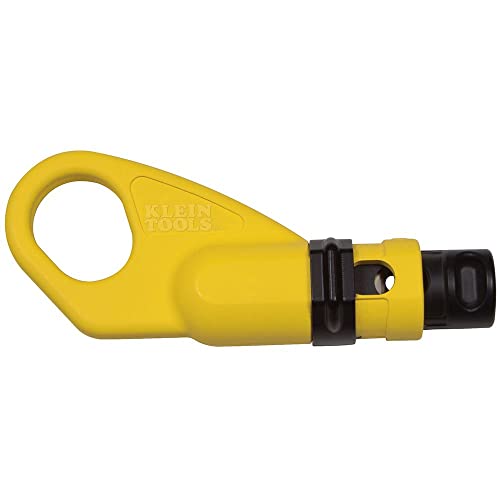
The VDV110-061 focuses on rapid, repeatable coax preparation. Its exclusive sliding cable stop pre-measures cable length for consistent stripping, and it handles RG59, RG6, and RG6Q cables. Best for professionals who value speed and repeatability in daily tasks, this tool also supports two-level coax prep (5/16″ and 1/4″). It can be less ideal for ultra-small cables or specialty connectors where precise depth control is necessary.
Cables Direct Online Rotary Coax Stripper Cutter

This rotary stripper is engineered for RG6 and RG59 RG59/6 family cables, offering fast, consistent strips. A rotation-based mechanism reduces manual effort, and the adjustable stripping depth lets users tailor the cut to insulation thickness. Best for installers who prioritize speed and a simple depth control, it may not cover the widest range of coax families compared to multi-tool sets.
mxuteuk 2 Pieces Coax Stripper Cutter Tool Set

The mxuteuk set includes two rotary coaxial cable strippers designed for a variety of RG types (RG59, RG58, RG6, RG11, RG8X, LMR cables). It offers a non-slip ABS handle and an adjustable blade depth similar to more expensive units, making it suitable for entry-level or on-the-go work. The main limitation is potential variability in cut precision across different cable jackets if users don’t dial in the depth carefully.
Buying Guide: Key Considerations for Coax Cable Cutters and Strippers
What should you consider when selecting a coax cutter or stripper?
- Cable diameter and type: Choose a tool that supports your most frequently used cables (RG6, RG59, RG11, hardline, fiber).
- Cut quality: Look for induction-hardened edges or chrome vanadium steel for durability and clean ends.
- Prep compatibility: Some tools are optimized for tube-like distortion prevention or quick pre-measuring stops.
- Hand fit and comfort: Ergonomic grips and non-slip handles improve accuracy and reduce fatigue during long sessions.
- Adjustability: Tools with adjustable stripping depth or dual-level prep are preferable for varied insulation thickness.
- Space constraints: Slim or compact designs perform better in tight cabinet or wall-mount setups.
- Maintenance: Hardened edges resist wear, but occasional lubrication and cleaning extend life.
FAQ
- What is the difference between a coax cutter and a stripper? A cutter typically performs clean cuts through the outer jacket, while a stripper removes insulation to expose the conductor for connectors. Some tools combine both functions in one unit.
- Which tool is best for RG6 and RG59 in residential work? A universal coax stripper with adjustable depth and two-level prep, like the Klein VDV110-061, is well-suited for common residential cables.
- Are rotary strippers better than manual ones? Rotary mechanisms can provide faster, more uniform strips with less manual effort, especially on multiple cables.
- Can these tools handle fiber cables? Some cutters are rated for larger fiber cables; always verify diameter and material compatibility before use.
- What maintenance keeps these tools in top condition? Regular cleaning, wiping away insulation debris, and applying light oil to moving parts extend blade life and ensure smooth operation.
- Should I buy a single-tool set or a multi-tool kit? If you work with multiple cable types and connectors, a multi-tool set provides versatility and value over time.