Best Blades to Cut Wood for DIY and Workshop Projects
The best blade to cut wood depends on the tool and the job: a fine-tooth circular blade suits smoother cuts, a reciprocating saw blade handles rough or outdoor work, and a Japanese pull saw offers manual control. The options below include blades for angle grinders, a hand saw, and a reciprocating saw. Before buying, confirm the blade fits your tool and follow the tool manufacturer’s safety instructions.
| Product | Best For | Key Detail |
|---|---|---|
| Echo Corner 40-tooth blade | Fine cuts with a compatible angle grinder | For wood and sheet materials |
| OA-BRES three-pack | General-purpose cutting | 40 teeth; 7/8-inch arbor |
| ONEGOTOOL three-pack | Woodworking and varied materials | Tungsten-carbide grit edge |
| EXTYQWC Japanese pull saw | Small, controlled hand cuts | Double-edge, 6-inch blade |
| SEDY reciprocating blade set | Woodcutting with a reciprocating saw | Multiple blade lengths and tooth counts |
Echo Corner 40-Tooth Wood Cutting Blades

These 4.5-inch blades have a 7/8-inch arbor and 40 ATB teeth. The listed materials include wood, plywood, MDF, veneer, particleboard, hardboard, and plastic. The carbide-tipped teeth are described as high-density tungsten carbide, and the product is sold as a two-pack.
Best for: Buyers seeking a fine-cut option for sheet goods or wood on a compatible angle grinder. Its 40-tooth design is the reason to consider it for smoother-edged cuts. Check the grinder’s manual and blade specifications before use; the listing does not establish compatibility with every grinder.
OA-BRES Three-Pack 40-Tooth Blades
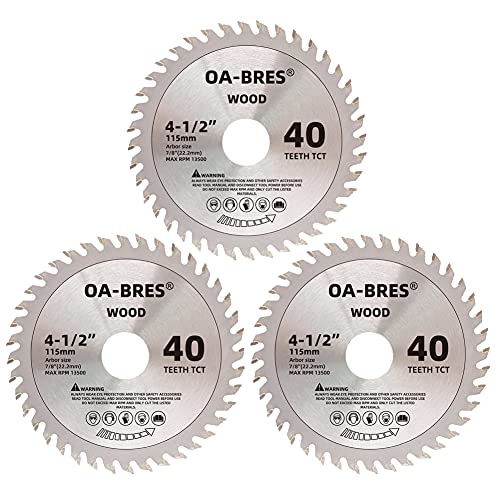
This three-pack of 4.5-inch, 40-tooth blades has a 7/8-inch arbor and includes a 5/8-inch reducing ring. The product features describe alloy-steel bodies, tungsten-carbide teeth, a polished and chrome-plated surface, and a thin kerf intended for smooth, fast cuts. The listing gives a maximum speed of 13,500 RPM.
Best for: Buyers who want multiple general-purpose blades for wood cutting and whose tool accepts the listed size and speed. Confirm the arbor, reducing ring, and maximum RPM against your tool’s requirements. Although the listing mentions several saw types, do not assume fit without checking the tool manual.
ONEGOTOOL Tungsten-Carbide Grit Discs

This three-pack is listed for wood, PVC, rubber, and tire cutting. Unlike a conventional toothed blade, its edge uses embedded tungsten-carbide grit. The listing describes the discs as lightweight and balanced, and claims the design reduces tooth-detachment risk and helps prevent jamming.
Best for: Buyers considering a grit-edge disc for woodworking and the other listed materials. The nontraditional edge is its key distinction from the 40-tooth options. Treat performance and safety statements as product claims, not a substitute for safe operation. The supplied details do not state the disc diameter or arbor size, so verify fit before purchasing.
EXTYQWC Double-Edge Japanese Pull Saw
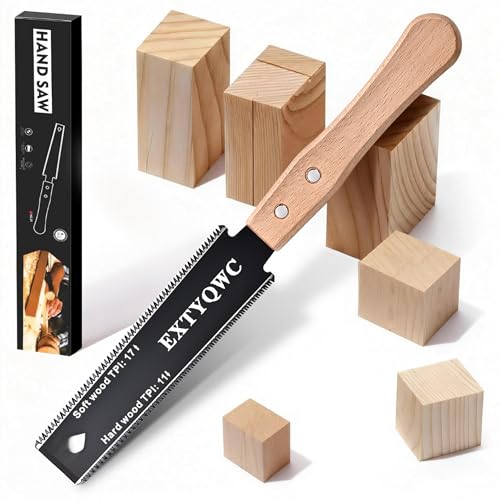
This manual saw has a 6-inch flexible SK5 high-carbon-steel blade with two tooth patterns: 17 TPI on one side and 11 TPI on the other. The listing identifies one side for hardwood and the other for softwood, and describes the tool for rip cuts, crosscuts, small woodworking jobs, and detail trimming.
Best for: People who want a hand-powered option for small, controlled cuts without choosing a powered-tool blade. The two edges provide different tooth counts for different wood tasks. Its 6-inch blade is a limitation for buyers who need a long reach or fast cuts through large stock.
SEDY Reciprocating Saw Blade Set

This 10-piece set includes 6- and 8-inch blades. Its assortment includes six-tooth-per-inch wood blades, metal-cutting blades, and blades listed for wood and soft metal. The wood blades are described as Cr-V steel, and the set comes with a storage box.
Best for: Buyers who need wood blades for a reciprocating saw and want several lengths for different tasks. The set is more versatile than a single-purpose wood blade because it includes options for metal and soft metal, too. Avoid choosing it if your tool requires a different blade connection or if you need a fine-finish circular-saw cut.
Buying Guide: How To Choose A Wood-Cutting Blade
Which tool will you use?
Start with the saw or power tool, not just the material. A circular blade, reciprocating blade, and hand-saw blade are not interchangeable. Match the blade style, diameter, arbor or connection, and permitted speed to the tool manual. For angle-grinder blades in particular, verify that the manufacturer allows the intended blade and cutting task.
Do you need a smooth finish or a rough cut?
Tooth count can help compare circular blades: the 40-tooth options listed here are aimed at smoother cuts than a coarse-tooth blade. Reciprocating blades in this selection have six teeth per inch on the wood-cutting versions, a coarser pattern suited to general or rough cutting rather than fine finish work. Choose a hand saw when control on a small job matters more than powered speed.
What materials will you cut?
Check the product’s stated materials before use. Some blades here list plywood, MDF, plastic, or other sheet materials in addition to wood. A blade described for wood should not automatically be treated as suitable for every composite, plastic, or metal. Select the blade for the specific material and cut, and follow the manufacturer’s directions.
What should you verify before buying?
- Confirm the blade diameter, arbor or attachment, and any included reducing ring match your tool.
- Check the maximum RPM where listed and do not exceed the tool or blade limit.
- Consider pack size and blade length based on the number and type of jobs.
- Use the guards and protective equipment required by the tool maker, and inspect blades before use.
Frequently Asked Questions
What blade is best for cutting wood smoothly?
A 40-tooth circular blade is a reasonable choice among these options for smoother cuts in listed wood and sheet materials. Fit and safe use depend on the tool specifications.
Can I use a wood-cutting blade on an angle grinder?
Only if the blade and grinder manufacturers permit that combination. Verify the blade size, arbor, maximum speed, and intended use in the product and tool instructions.
Is a higher tooth count always better for wood?
No. Tooth count is one factor in cut quality and speed. Match the blade to the material, desired finish, tool, and task.
Which option is best for small woodworking cuts?
The 6-inch Japanese pull saw is listed for small woodworking and detail trimming, with separate tooth patterns for hardwood and softwood.
What is a reciprocating saw blade set best for?
The SEDY set is suited to buyers using a reciprocating saw who want several wood-blade lengths, plus blades listed for metal and soft metal.