Best Apartment Balcony Pulley Systems for Controlled Lifting
The best apartment balcony pulley system depends on the load, rope reach, and a safe, approved anchor point. Of these options, the VEVOR is best for long reach, the YATOINTO 8:1 models are better for reducing pulling effort, and the stainless-steel two-pack suits lighter-duty setups. These are general-purpose lifting products, not systems identified as balcony-rated. Check building rules and consult a qualified professional about anchoring before lifting anything from a balcony.
| Product | Best suited for | Key listed detail |
|---|---|---|
| VEVOR Rope Pulley Hoist | Longer vertical reach | 100-foot rope; 5:1 ratio |
| YATOINTO With Tow Straps | More mechanical advantage | 8:1 ratio; two slings |
| YATOINTO Rope Hoist | Heavy-duty lifting tasks | 8:1 ratio; zinc-plated housing |
| Stainless-Steel Pulley Two-Pack | Light-duty, two-pulley setups | 32-foot rope; stated 550-pound lifting capacity |
| XSTRAP STANDARD Rope Hoist | Shorter reach with soft loops | 50-foot rope; stated 1,000-pound working load |
VEVOR 100-Foot Rope Pulley Hoist

Best for: Buyers who need extra rope reach for a planned lift and want a block-and-tackle system with a stated 5:1 lifting ratio. The listing specifies 100 feet of 6 mm polyester rope, metal pulleys with bearings, and two soft loops. The rope is described as wear- and tear-resistant.
The listing gives a 4400-pound breaking strength and recommends a working load of 1100 pounds. These are different measurements: breaking strength is not a safe working capacity. Choose this model when rope length is a priority, but do not treat the breaking-strength figure as the allowable load. The listed features do not establish that it is rated for balcony installation or for lifting over people.
YATOINTO 8:1 Hoist With Tow Straps
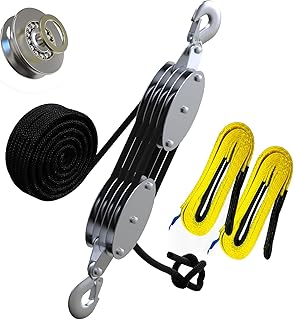
Best for: Buyers seeking an 8:1 ratio and included attachment slings. This set has 65 feet of diamond-braid polypropylene rope, metal wheels with a bearing structure, and two 1-inch-by-8-foot lifting slings. The slings have loop ends, which the listing says can attach to shackles or hooks.
The 8:1 ratio is intended to reduce the pulling effort compared with a lower-ratio arrangement, though actual effort also depends on friction and the load. The product listing states 4400 pounds of breaking strength, not a working-load limit. Do not infer a safe balcony load from that number; confirm an applicable working-load rating and ensure the anchor and connections are suitable.
YATOINTO Heavy-Duty 8:1 Rope Hoist

Best for: Shoppers comparing an 8:1 block-and-tackle design with a metal hook and rust-resistant housing. Its listed features include 65-foot diamond-braid polypropylene rope, a zinc-plated housing, alloy-steel hook, and metal bearings.
The listing describes 4400 pounds of breaking strength and a 2200-pound load capacity. Confirm what the stated capacity represents and follow the manufacturer’s instructions before use. This model may suit buyers who want the pulley components supplied together, but its listed features do not confirm suitability for a particular balcony railing, ceiling, or building structure.
Stainless-Steel Pulley Two-Pack

Best for: Lighter-duty lifting where a two-pulley arrangement and corrosion-resistant components are priorities. The listing includes two pulleys, 32 feet of rope, and hooks. Each pulley has two bearings and a 360-degree swivel ring; the product is described as stainless steel with bearing-steel bearings.
The listing states that combining the two pulleys can create a 2:1 system and gives a 550-pound lifting figure. Verify whether that capacity applies to each pulley or the complete setup before loading it. This is a shorter-reach option than the 65- and 100-foot hoists, and the listed details do not establish a balcony-specific load rating.
XSTRAP STANDARD 50-Foot Rope Hoist

Best for: Buyers who need less rope than the longest options and want soft loops included. It has 50 feet of 4.5 mm polypropylene rope, metal wheels with bearings, zinc-plated housing, safety hooks, and two 18-inch soft loops.
The listing states a 2000-pound breaking strength and a 1000-pound load capacity. Treat the stated load capacity as distinct from breaking strength, and check the product instructions for its precise working-load guidance. Its 50-foot reach is shorter than the VEVOR’s, so measure the lift path before choosing it.
Buying Guide: Choosing a Balcony Pulley System
How much rope reach do you need?
Measure the full distance from the anchor point to the load, including the rope needed to route through the pulleys and leave a usable pulling tail. The listed lengths range from 32 to 100 feet. Extra rope does not make an unsafe anchor safer, and a longer line may be harder to manage in a confined area.
What does the lifting ratio tell you?
A higher mechanical advantage, such as 8:1 compared with 2:1, can reduce the pulling effort needed for a load. It also generally requires more rope to move the load a given distance. Ratios alone do not establish maximum safe load; use the manufacturer’s working-load instructions for the complete system.
How should you assess load capacity and anchoring?
Do not confuse breaking strength with working-load capacity. Confirm ratings for the hoist, rope, hooks, slings, and every connection, and account for the anchor and supporting structure. A balcony railing may not be designed for lifting forces. Follow building rules and obtain qualified advice rather than attaching a hoist to an unverified railing or fixture.
What safety precautions matter?
- Keep people clear of the suspended load and the area below it.
- Do not lift people or use the system as a fall-protection device.
- Inspect rope, hooks, pulleys, and slings for damage before use.
- Do not exceed the lowest applicable working-load rating in the setup.
Frequently Asked Questions
Can I attach a pulley system to an apartment balcony railing?
Not without confirming that the railing and connection are approved for the lifting forces. A railing’s ordinary use does not prove it is a suitable hoist anchor.
Which option has the longest rope?
The VEVOR listing specifies 100 feet of rope, longer than the other listed options.
Is breaking strength the same as working-load capacity?
No. Breaking strength describes a failure-related limit, not a routine safe working load. Use the manufacturer’s working-load guidance.
Does a higher pulley ratio make lifting risk-free?
No. A higher ratio can reduce pulling effort, but it does not remove the need for a rated system, secure anchoring, and a clear lifting area.