Best Acrylic Circular Saw Blades for Clean Plastic Cuts
The best acrylic circular saw blade depends on the saw, material thickness, and cut quality you need. For blades explicitly designed for acrylic and Plexiglas, consider the IVY Classic 60-tooth blade or the CMT Orange Tools 80-tooth blade. The FOXBC options suit buyers seeking fine-tooth blades for mixed sheet materials, while Benchmark Abrasives is designed for a wider range of non-metal materials. Check blade diameter and arbor size before buying.
| Blade | Best For | Key Detail |
|---|---|---|
| IVY Classic | Acrylic and solid surfaces | 7-1/4-inch, 60-tooth carbide blade |
| CMT Orange Tools | Plexiglass and thin plastics | 10-inch, 80-tooth blade |
| FOXBC 7-1/4-Inch | Fine cuts in sheet materials | 140 teeth; three-pack |
| FOXBC 4-1/2-Inch | Compact trim-saw applications | 120 teeth; three-pack |
| Benchmark Abrasives | Mixed non-metal cutting | 7-1/4-inch, 80-tooth blade |
IVY Classic 7-1/4-Inch Plastic Cutting Blade

Best for: Buyers who want a blade specifically described for acrylic sheets, Plexiglas, plastics, and solid-surface materials. Its 7-1/4-inch diameter and 60 teeth make it a direct option for compatible circular saws.
The blade uses triple-chip-ground, modified tungsten carbide teeth and a fully hardened body. These listed features distinguish it from general-purpose blades that only mention plastic among several materials. It is sold as one blade.
Limitation: Confirm the arbor fit before purchase. The listing specifies a 5/8-inch diamond knockout arbor, so it may not fit a saw requiring a different arbor configuration.
CMT Orange Tools 10-Inch Plexiglass Blade

Best for: Buyers using a compatible 10-inch slide miter saw, squaring machine, or stationary table saw to cut Plexiglass or thin plastics. The product is explicitly identified for those materials and has 80 teeth.
Its listed construction includes a laser-cut steel plate, heat-expansion slots, sound-dampening slots, a tensioning ring, and tri-metal brazing. These are useful points of comparison for shoppers considering a larger stationary-saw blade rather than a compact handheld-saw blade.
Limitation: This is a 10-inch blade with a 5/8-inch bore. Check both saw compatibility and the material’s thickness before choosing it; the listing specifically calls out thin plastics.
FOXBC 7-1/4-Inch 140-Tooth Blade
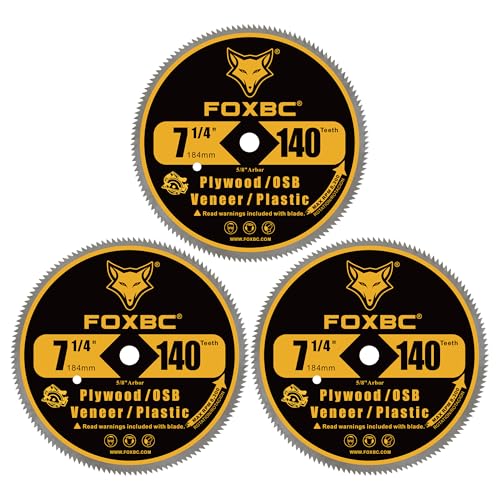
Best for: Buyers who need a high-tooth-count blade for plywood, OSB, plastic, paneling, veneer, and vinyl siding. Its 140 teeth, 7-1/4-inch diameter, and listed 0.086-inch kerf make it a fine-finish option among the products compared here.
The listing describes smooth cutting and reduced splintering in sheet goods, including crosscuts and miter edges. It comes as a three-pack, which may suit buyers who want multiple blades for ongoing work.
Limitation: Acrylic is not specifically named in the provided product details. Choose a blade explicitly labeled for Plexiglas if acrylic is your main material, and verify the 5/8-inch arbor and diamond knockout fit your saw.
FOXBC 4-1/2-Inch 120-Tooth Blade

Best for: Buyers whose compatible saw takes a 4-1/2-inch blade and who want a fine-tooth option for plywood, OSB, plastic, veneer, paneling, or vinyl siding. The 120-tooth count and three-pack format are the main distinguishing features.
FOXBC describes the blade as intended for smooth cuts, including miter edges and crosscuts in sheet materials. It is a smaller-diameter alternative to the 7-1/4-inch FOXBC blade, so the saw’s required blade size should guide the choice.
Limitation: The listed arbor is 3/8 inch, and acrylic is not specifically named. Avoid choosing it based on tooth count alone; confirm the arbor and saw requirements first.
Benchmark Abrasives 7-1/4-Inch 80-Tooth Blade

Best for: Buyers who cut a variety of non-metal materials and want one blade for materials such as PVC, fiberglass, aluminum, brass, and copper. The product is a 7-1/4-inch, 80-tooth TCT blade described for non-ferrous and non-metal cutting.
The listing highlights carbide tips and tooth geometry intended to support accurate tracking and clean cuts across sheet panels, profiles, trim, and plastic components. It is a broader-use alternative to blades whose descriptions focus specifically on acrylic.
Limitation: Acrylic is not specifically mentioned in the provided features. If acrylic is the primary material, the IVY Classic or CMT blade has more direct material guidance. Check the saw’s arbor requirements, which are not provided here.
Buying Guide: How to Choose an Acrylic Circular Saw Blade
Is the blade specifically intended for acrylic?
Start with the material description. The IVY Classic names acrylic sheets and Plexiglas, and CMT identifies Plexiglass and thin plastics. The FOXBC and Benchmark listings include plastic or other non-metals but do not specifically name acrylic. A direct material match is a useful selection factor when comparing products.
What blade size and arbor does your saw require?
Match the blade diameter and arbor to the saw’s specifications before buying. The options here range from 4-1/2-inch to 10-inch diameters and list different arbor details. Tooth count cannot compensate for a blade that does not fit the tool. Check any knockout or bore configuration as well.
How should tooth count affect the choice?
Tooth count is one comparison point, not a guarantee of a particular finish. The products range from 60 to 140 teeth. Consider the blade’s stated material use, diameter, and saw compatibility together. The 140-tooth FOXBC is described for fine cuts in sheet materials, while the CMT and IVY products provide more explicit plastic guidance.
Should you choose a dedicated or multi-material blade?
Choose a blade with explicit acrylic or Plexiglas guidance when plastic sheet cutting is the priority. A broader non-metal blade may make sense when the work also includes materials such as PVC, fiberglass, or metals, but verify that acrylic is listed or otherwise supported by the manufacturer before use.
Frequently Asked Questions
Which listed blade is most directly described for acrylic?
The IVY Classic listing specifically names acrylic sheets and Plexiglas. The CMT blade is also directly described for Plexiglass and thin plastics.
Can a blade labeled for plastic cut acrylic?
Not every listing establishes that it is suitable for acrylic. Check the manufacturer’s material guidance; among these products, some name acrylic or Plexiglas directly and others do not.
Does a higher tooth count always make a better acrylic blade?
No. Tooth count is only one factor. Confirm the intended material, blade size, arbor fit, and saw compatibility as well.
What should I check before installing a blade?
Confirm the diameter, arbor or knockout configuration, and the saw’s requirements. Follow the saw and blade manufacturers’ instructions for installation and operation.