Best AC Circuit Breaker Finder Picks for Efficient Electrical Troubleshooting
Answering the need for quick, reliable breaker location and wiring checks, these AC circuit breaker finders are ideal for electricians, DIYers, property managers, and maintenance staff working with North American 120V systems. Each top pick combines a circuit finder, outlet tester, and GFCI tester in a single tool. The right choice depends on your work environment, panel access, and preference for LCD feedback versus portability.
Summary table of selected products
| Product | Key Strength | Best For | Limitations |
|---|---|---|---|
| KT301P by KAIWEETS | Large LCD, GFCI tester, NCV and flashlight | Pro-like diagnostics in tight panels | Transmitter/receiver design may require familiarization |
| Klein Tools ET310KIT | Clear cues, built-in GFCI tester | Professional electricians needing a complete kit | Higher price for a kit vs. basic models |
| KT302P by KAIWEETS | All-in-one, dual-sided LED indicators | Homeowners and DIYers with frequent testing | Two-scan process may require practice |
| KT303P by KAIWEETS | Nestable transmitter/receiver, NCV, flashlight | Troubleshooting in dim panels or tight spaces | More complex feature set; learning curve for beginners |
| Focemta Circuit Breaker Finder Kit | Dual function LCD, voltage readout | Electrical work in diverse environments | Less widely reviewed in some markets |
KT301P: All-in-One Breaker, Outlet, and GFCI Tester

The KT301P blends a circuit breaker finder, an outlet tester, and a GFCI tester into a single compact tool. It reads real-time voltage (30–150V) and reveals outlet wiring status on a large LCD with backlighting. This makes it easier to diagnose seven common wiring faults and confirm GFCI protection. The auto-hold feature retains results after unplugging, helping maintain a clear record in busy workspaces. Best for professionals who need fast, integrated diagnostics in 120V systems and for DIYers tackling complex panels.
Who it’s best for: electrical pros and serious DIYers who want an all-in-one device with clear visual data in dim panels. Caution: understanding the LCD readouts may require a short acclimation period for new users.
ET310KIT AC Circuit Breaker Finder Kit

The ET310KIT from Klein Tools emphasizes accurate breaker identification on 90–120V AC circuits, with a transmitter and receiver that provide clear visual and audible cues when the target breaker is located. A built-in GFCI tester on the transmitter enables quick checks of wiring conditions and GFCI devices, enhancing safety for both professional electricians and experienced DIYers working on complex panels.
Who it’s best for: users who want a reliable, visually clear procedure and an integrated GFCI test capability. Caution: the kit’s effectiveness depends on proper alignment of transmitter and receiver in crowded panels.
ET310: AC Circuit Breaker Finder with GFCI Tester
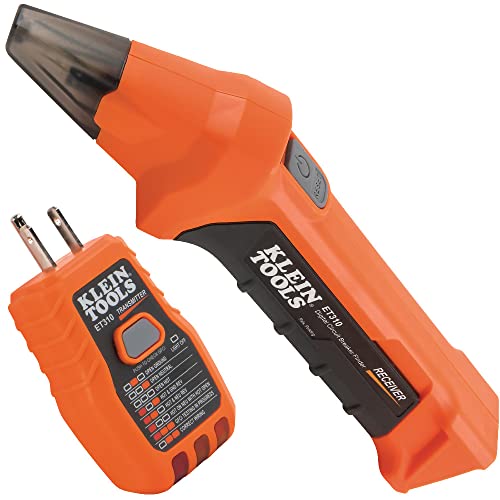
This Klein Tools model centers on accurate breaker identification via a two-part system: a transmitter connected to outlets or fixtures and a receiver that scans the panel. The receiver delivers clear indications—visual cues and an audible signal—when the correct breaker is found, which reduces guesswork in 120V circuits. It pairs well with other Klein Tools testers for a comprehensive electrical diagnostics workflow.
Who it’s best for: technicians who value straightforward operation and reliable audible feedback. Caution: it performs best when used with typical 120V residential circuits and may be less optimal in nonstandard wiring environments.
KT302P: All-in-One Circuit Finder with Dual-Sided LEDs

The KT302P extends the all-in-one approach with dual-sided LED indicators and a built-in flashlight. It traces circuits on 90–120V AC, using a two-scan method—learn first, then locate—helping avoid misidentifying breakers in busy panels. The device is well-suited for homeowners and maintenance professionals who need a portable, reliable tool for routine breaker tracing and GFCI checks.
Who it’s best for: DIYers and small-service teams that prioritize a simple workflow and strong visual feedback. Caution: early users may need to practice the two-scan process to maximize accuracy.
KT303P: LCD Display with NCV and GFCI Tester

The KT303P combines an all-in-one circuit finder with a large LCD display and non-contact voltage (NCV) testing. It stores the transmitter and receiver together in a nestable design for easy transport. Its GFCI testing and multiple scan modes help identify wiring faults quickly, while the built-in flashlight improves visibility in crowded panels. This model is suitable for professionals who need precise, real-time data and compact portability.
Who it’s best for: professionals and seasoned DIYers who value integrated data display and compact storage. Caution: the nesting design may require careful initial setup to prevent misplacing parts during transport.
Focemta Circuit Breaker Finder Kit

The Focemta kit offers a comprehensive all-in-one approach with a GFCI tester, real-time voltage readout, and a set of adapters for varied outlets and cords. Its accessories—light socket adapter and grounding adapters—facilitate testing in diverse wiring scenarios. The large LCD displays voltage and signal strength, supporting precise tracing and quick fault diagnosis for both home improvement and professional settings.
Who it’s best for: users who need broad testing capability and practical accessories for different outlet configurations. Caution: availability and regional support may vary by seller.
Buying Guide: How to Choose the Right AC Circuit Breaker Finder
What features matter most for your workflows?
- All-in-one capability: If you frequently test breakers, outlets, and GFCI status, prioritize models like KT301P, KT302P, or KT303P that combine functions in one tool.
- Display and readability: A large LCD with backlight helps in dim panels. Consider models with dual-color backlighting and clear LED indicators.
- Voltage range and accuracy: Look for devices rated for 90–135V or 90–150V as appropriate for your circuits and a clear voltage readout for diagnostic confidence.
- Ease of use: Two-scan tracing, nestable transmitters, and audible cues reduce the time to identify the correct breaker, especially in busy or multi-panel environments.
- Portability and durability: Portable kits with carrying cases and compact form factors suit fieldwork and tight spaces.
- GFCI testing capability: Built-in GFCI testers help verify outlet protection, a critical safety feature for many installations.
Practical tips for use
- Calibrate and test the device in a known outlet first to confirm readings before moving to a live panel.
- Use the flashlight feature when inspecting dark breaker panels or confined spaces.
- Retain test results with auto-hold or battery backup features for record-keeping and audits.
Common questions
- Do I need a separate tester for GFCI outlets, or is it included? Some models include a built-in GFCI tester as part of the tool.
- Is it safe to use these tools on live panels? These tools are designed for safe testing, but follow all safety guidelines and manufacturer instructions.
- Can these devices identify the exact electrical circuit causing a fault? They help locate the correct breaker and identify wiring faults, but complex issues may require additional diagnostic steps.
- How do I store the transmitter and receiver? Nestable designs and carrying cases help prevent loss in transit.
- What voltage range is standard for 120V circuits? Most tools are optimized for 90–120V or 90–135V circuits commonly found in North America.
- Are there differences between professional kits and hobbyist models? Kits with multiple accessories and higher-grade indicators are typically aimed at professionals, while simpler tools serve DIY tasks.