Best Abrasive Nylon Wheel Brushes for Rust, Paint, and Surface Prep
The best abrasive nylon wheel brush depends on the work area, surface, and level of abrasion needed. The POLIWELL set is best for buyers who want multiple brush shapes and three grades; Rocaris suits general-purpose cleaning across several materials; and Mixiflor offers the widest listed grit range. For a single large coarse brush, consider Century Drill & Tool. The options below use abrasive-embedded nylon bristles for tasks such as removing light rust, paint, and surface buildup.
| Product | Best For | Notable Feature |
|---|---|---|
| POLIWELL 9 Pack | Shape and grit choices | Cup, wheel, and end brushes |
| Rocaris 9 Pack | General-purpose cleaning | Hex shanks for drills and impact drivers |
| SALI 6 Pack | Multiple brush sizes | Six shapes and sizes |
| Mixiflor 7 Pack | Progressive grit selection | Seven listed grit levels |
| Century Drill & Tool 4-Inch | Coarse, larger-area work | Aluminum oxide nylon bristles |
POLIWELL 9 Pack Nylon Abrasive Brush Set
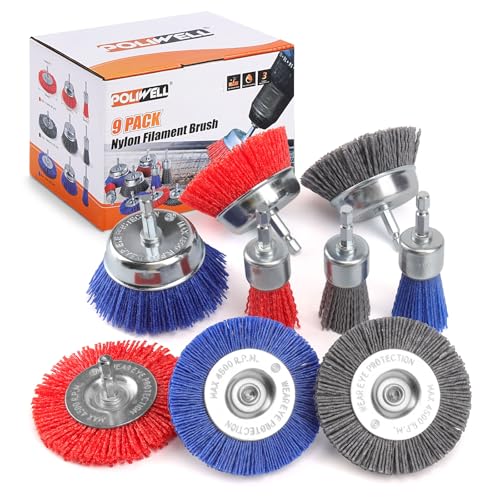
Best for buyers who need different brush profiles and grades for varied jobs. The set includes 3-inch cup and wheel brushes plus a 1-inch end brush, with red 80-grit, gray 100-grit, and blue 220-grit options. The cup brush is intended for larger uneven surfaces, while the wheel brush suits directional strokes and the end brush reaches confined spaces.
The nylon bristles contain abrasive grains and are described as heat resistant, non-rusting, and suitable for wet or dry use. The product listing says they create less surface damage than some alternatives and shed very little. Choose this set when access and brush shape matter as much as grit. Its limitation is that it does not list a finer grade than 220 grit.
Rocaris 9 Pack Nylon Brush Wheel And Cup Set

Best for general light cleaning and paint or rust removal across several material types. Rocaris lists use on metal, steel, stainless steel, wood, aluminum, plastic, PVC, tile, and stone, in wet or dry applications. Its cup and wheel brushes have 1/4-inch hex shanks and are listed as fitting drills and impact drivers.
The manufacturer describes the synthetic nylon bristles as chemical resistant and non-sparking, and says they will not rust or corrode. That broad material range makes this a flexible choice for mixed household or workshop projects. Avoid assuming it is suitable for aggressive stock removal: the listed use focuses on light rust and paint removal, and the supplied details do not specify grit grades.
SALI 6 Pack Nylon Brush Set

Best for buyers who want several brush diameters and profiles without choosing a larger assortment. This six-piece kit includes a 1-inch pen brush, flat brushes measuring 2, 3, and 4 inches, and bowl brushes measuring 1-3/4 and 2-1/2 inches. The listed 1/4-inch hex shank is intended for drill use.
Abrasive grit is embedded in the nylon strands. The listing identifies rust, corrosion, sanding, scuffing, and deburring among its uses on metal, wood, plastic, and ceramic surfaces. Choose SALI when you need both narrow access and broader contact areas. The listed features do not specify individual grit grades, so this set offers less grit-selection detail than the POLIWELL or Mixiflor options.
Mixiflor 7 Pack With Seven Grits
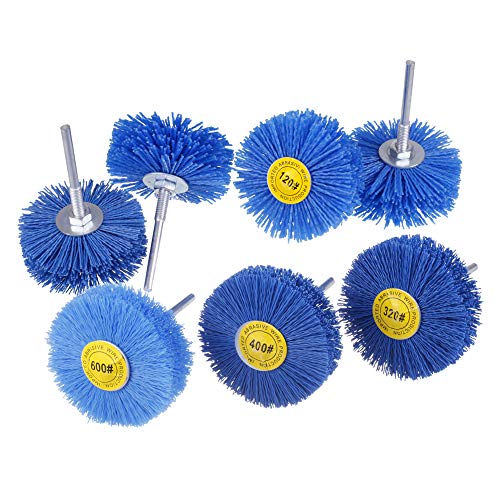
Best for users who want a broad range of listed abrasiveness levels. Mixiflor identifies seven grits: 80, 120, 180, 240, 320, 400, and 600. That range can help buyers select a grade suited to the task, from more assertive surface work to finer preparation. The listed brush diameter is 3.20 inches, and its shank measures 6 mm in diameter and 70 mm long.
The nylon bristles are described as flexible, wear-resistant, and less likely to scratch a surface than metal bristles. The product is also described as non-sparking. Choose this set when grit range is the priority. Check your tool’s chuck or holder before buying, because the listed shank is 6 mm rather than a stated 1/4-inch hex shank.
Century Drill & Tool 4-Inch Coarse Brush
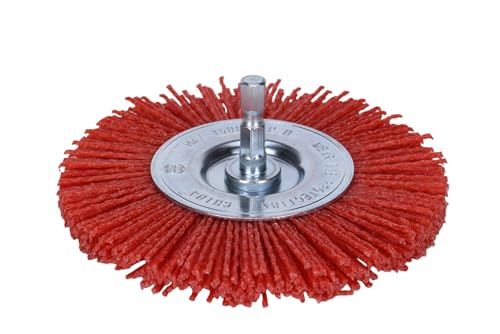
Best for buyers seeking one larger coarse brush for cleaning and surface preparation. This 4-inch radial brush uses aluminum oxide-impregnated nylon bristles, which the listing says hold their shape longer than standard wire brushes. Its stated applications include removing paint, rust, corrosion, and finishes from metal, wood, plastic, fiberglass, rubber, tile, stone, and brick.
The non-sparking nylon design may suit work around flammable materials or sensitive surfaces, according to the product description. Choose it when a single coarse brush is more useful than a multi-piece assortment. Its limitation is straightforward: it is listed as coarse, so buyers who need several grit levels or smaller brush profiles should compare it with a set.
Buying Guide: How To Choose An Abrasive Nylon Wheel Brush
Which brush shape fits the work area?
Cup brushes cover larger or uneven surfaces. Wheel brushes are useful when a consistent stroke direction is needed, while end or pen brushes can reach smaller spaces. For varied jobs, a kit with several shapes reduces the need to rely on one profile.
How should you compare grit?
Compare the grit numbers and color codes listed for each set rather than relying on color alone. POLIWELL lists 80, 100, and 220 grit; Mixiflor lists seven grades from 80 through 600. A wider range gives more choice, but the right grade depends on the surface and removal task.
Will the shank fit your tool?
Check the brush shank against the tool’s chuck or holder before purchase. Several sets here list a 1/4-inch hex shank, while Mixiflor specifies a 6 mm shank. Do not assume that all drill brushes use the same attachment.
What materials and conditions matter?
Confirm that the listed applications include your work material. Some products name a broad range of materials, while others describe fewer. Check the product’s instructions for operating limits and suitable wet or dry use; do not infer conditions that are not specified.
Frequently Asked Questions
What is an abrasive nylon wheel brush used for?
It is used for tasks such as removing light rust, paint, corrosion, or surface buildup and for sanding, scuffing, or deburring, depending on the brush and material.
Is a nylon abrasive brush the same as a wire brush?
No. These products use nylon filaments with abrasive material embedded in them, rather than ordinary metal wire bristles.
Can abrasive nylon brushes be used on wood?
Several products listed here specify wood as a suitable application. Select a brush and grit appropriate for the task, and follow the product instructions.
Do all these brushes fit an impact driver?
No universal fit is established. Rocaris specifically lists compatibility with drills and impact drivers; check the shank and tool requirements for other products.
Are these brushes suitable for wet use?
Some listings specify wet or dry use, including Rocaris and POLIWELL. Check the specific product information before using another brush in wet conditions.