Best 8 Inch Variable Speed Bench Grinder for Every Shop
Answering the common buyer question: which 8 inch variable speed bench grinder fits my needs? This guide reviews five strong options, highlighting who each is best for and why. It covers high-speed, low-speed, dual-speed, and digital-display models to help woodworkers, metalworkers, jewelers, and hobbyists pick confidently. Each section notes the ideal user and a key trade-off to consider.
| Product | Best For | ||
|---|---|---|---|
| BUCKTOOL 8″ 1HP High Speed | Heavy metal deburring and shaping | High RPM with wobble-free wheel design for precision | Higher speed may require more cooling and PPE |
| Woodskil 8″ 3/4HP High Speed | Knife makers and jewelers | Versatile 3600RPM with AO wheels | Two wheels with different grits may require setup time |
| Woodskil 8″ 1/2HP Dual Speed | Beginner to intermediate metalwork | Two-speed operation for polishing and grinding | Lower horsepower than single-speed variants |
| BUCKTOOL 8″ 3/4HP Low Speed | Carpenters and carvers | Low-speed with CBN wheel option for precise sharpening | Lower speed may be slower for heavy stock removal |
| Woodskil Digital Display 8″ Variable Speed | Precision-focused workbenches | Digital RPM readout aids exact control | Higher tech features may require calibration |
Note: The table provides a quick snapshot. Each product section below expands on who it’s for and why it was selected, with practical considerations to help you compare and decide.
BUCKTOOL 8″ 1HP High Speed Bench Grinder
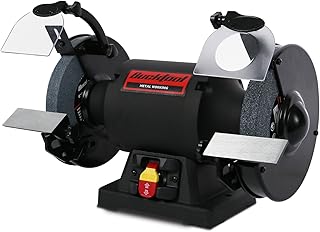
BUCKTOOL 8″ 1HP High Speed Bench Grinder
Best For: Heavy deburring, shaping, and metal prep in a shop that handles frequent material removal. Choose this for high RPM and a wobble-free wheel setup. Caution: Higher speed can increase heat; ensure adequate cooling and PPE is worn during use.
BUCKTOOL 8″ 3/4HP Low Speed Bench Grinder

BUCKTOOL 8″ 3/4HP Low Speed Bench Grinder
Best For: Carpenters and turners who need precise sharpening with a slower grind rate. This model uses a CBN wheel and a wide WA wheel to support various chisels and gouges. Limitation: Lower speed may reduce material removal rate on tough metals.
Woodskil 8″ 1/2HP Dual Speed Benchtop Buffer

Woodskil 8″ 1/2HP Dual Speed Benchtop Buffer
Best For: Jewelers and hobbyists who need polishing and light grinding in one machine. The dual-speed design provides 1725 and 3450 RPM with extended shafts for smooth surfaces. Caution: Not ideal for heavy stock removal; use the appropriate wheel for polishing versus grinding.
Woodskil Digital Display 8″ Variable Speed

Woodskil Digital Display 8″ Variable Speed
Best For: Professionals needing precise speed control with real-time RPM feedback. The digital readout helps maintain consistent grinding results across varied materials. Limitation: More complex electronics may require careful setup and occasional calibration.
Woodskil 8″ 3/4HP High Speed Bench Grinder For Metal
Woodskil 8″ 3/4HP High Speed Bench Grinder
Best For: Knife makers and jewelry work requiring high-speed metal finishing with stable performance. The AO wheels and adjustable rests support precise shaping. Caution: Ensure wheel alignment and guard clearance are correct to avoid contact with workpieces at high speeds.
Buying Guide
What to consider when choosing an 8″ variable speed bench grinder
- Horsepower and speed range: Higher HP and RPMs remove material faster but generate more heat. Choose based on the type of metal and scale of tasks.
- Wheel type and size: 8″ wheels provide broad contact; consider grain type and availability (AO, CBN, or standard abrasive wheels) for your tasks.
- Motor type and speed control: Variable speed and dual-speed options add versatility for sharpening, deburring, and polishing.
- Tool rests and shields: Adjustable rests improve accuracy; multiple eye shields reduce sparks and debris exposure.
- Base construction and vibration: Cast iron bases and wobble-free designs improve stability during heavy use.
- Workspace and safety: Ensure adequate bench space, dust extraction, and PPE readiness.
Practical buying questions
- Which grinder is best for sharpening chisels and gouges?
- Do I need dual-speed or digital RPM readout for my projects?
- How important is wheel alignment and wobble control?
- Is a low-speed grinder better for high-precision polishing?
- What maintenance does a variable speed grinder require?
Quick comparison tips
- Best for heavy metal removal: high-speed single horsepower models with robust wheels.
- Best for precise sharpening: low-speed models or dual-speed setups with accurate tool rests.
- Best for polishing and jewelry: dual-speed or buffer-style units with soft wheels.
FAQ
- What RPM range should I expect from an 8″ variable speed grinder?
Typical options span from about 1500 to 3450 RPM, depending on the model. - Are 8″ grinders safer than smaller models?
They offer more surface area but require proper guards, shields, and PPE to manage heat and sparks. - Is a digital RPM display necessary?
Not essential, but it helps with repeatability in precision tasks. - Can I use a bench grinder for knife making?
Yes, especially models with adjustable rests and accurate speed control; use appropriate wheels. - What maintenance does a variable speed grinder need?
Regular cleaning, wheel truing, bearing lubrication if specified, and guard checks. - Which configuration is best for a beginner?
A dual-speed or mid-range variable-speed model with clear safety features and adjustable rests.