Best 72 Inch Bandsaw Blade Options for Woodworking
Finding the right 72 inch bandsaw blade depends on your cutting material and the saw model you own. This guide highlights five high-compatibility blades, each suited for common American bandsaw setups like Delta 28-140, Wen 10-inch models, and Shopsmith systems. The top picks emphasize durability, consistent teeth engagement, and predictable finishes for wood, PVC, and thin aluminum. Whether you’re a hobby woodworker or a professional shop operator, these blades aim to deliver clean resaws, smooth curves, and reliable long-cut performance.
| Product | Best For |
|---|---|
| AYAO 72-inch Bandsaw Blades Assortment (3 Pack) | General wood cutting and versatile blade choice |
| FOXBC 72 Inch X 1/4 Inch X 14 TPI Bandsaw Blades | Precise crosscuts and fast material removal |
| AYAO Hardened Teeth 72 Inch X 1/2 Inch X 4TPI | Resawing hardwoods and heavy stock |
| AYAO 72-Inch X 1/8 Inch X 12TPI | Fine cuts and curved work in wood |
| Timber Wolf Bandsaw Blade 1/2″ x 72″, 4 TPI | Heavy stock and long resaws with precise control |
AYAO 72-inch Bandsaw Blades Assortment

This 3-pack includes blades sized 72″ by 1/8″ (12 TPI), 72″ by 1/4″ (10 TPI), and 72″ by 3/8″ (6 TPI). It fits popular 10″ Delta 28-140, 10″ Wen, and 11″ Shopsmith bandsaws. Best for wood, PVC, and thin aluminum. The variety enables quick switching between fine, general-purpose, and thicker-thin work. A limitation is that the 3-pack covers only a subset of blade geometries; you may still need a high-tooth count option for tight curves. Best for DIY shops needing a budget-friendly starter set for multiple wood projects.
Who it’s best for: hobbyists who own multiple small to mid-size saws and want a ready set for light to medium cutting tasks. Why selected: the included 12 TPI, 10 TPI, and 6 TPI blades cover common needs without swapping blades frequently.
FOXBC 72 Inch X 1/4 Inch X 14 TPI Blades

Two-piece 72″ blades at 1/4″ width and 0.014″ thickness cater to 72″ long saws like WEN 3962 and Delta 28-140. The 14 TPI tooth configuration focuses on cleaner, faster cuts with less dwell time in material. Best for square-edged cuts and efficient stock removal in soft to medium-hard woods. A caution: 1/4″ width is less forgiving on very tight curves; choose this if you primarily cut straight or gently curved profiles.
Who it’s best for: woodworkers who primarily perform straight-rip cuts or wide, shallow curves. Why selected: balanced between speed and smoothness for common 72″ saws.
AYAO 72-Inch Band Saw Blade X 1/8″ X 12TPI

This blade is designed to fit 10″ Delta 28-140, 10″ Wen, and 11″ Shopsmith bandsaws with a 72″ length, 1/8″ width, and 12 TPI. The 12 TPI tooth count supports fine cutting and smooth edge finishes in wood and light plastics. A key strength is its welded construction, intended to reduce tooth loss at higher speeds. Limitation: thinner blades can be more prone to deflection on very thick stock or aggressive resaw tasks.
Who it’s best for: users doing fine, precise cuts and curved work where edge quality matters. Why selected: for intricate patterns and smoother curves, 12 TPI performs consistently well.
AYAO Hardened Teeth 72 Inch X 1/2 Inch X 4TPI
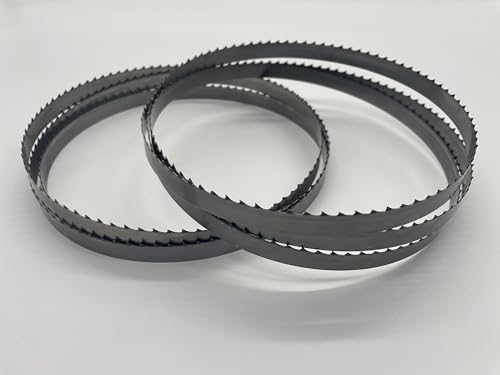
With hardened teeth and a 1/2″ width, this blade is built for heavy-duty wood cutting and resaw work. It fits 10″ Delta 28-140, 10″ Wen, and 11″ Shopsmith bandsaws. The 4 TPI configuration prioritizes stability and fast stock removal on thicker stock while resisting dulling in hardwoods. A potential limitation is that 4 TPI may be too coarse for very fine, detailed work on small pieces.
Who it’s best for: users performing frequent resawing and heavy stock removal. Why selected: hardened teeth extend edge life under demanding cuts and reduce frequent blade changes.
FOXBC 72 Inch X 3/8 Inch X 6 TPI Blades

This blade matches 72″ bandsaws like WEN 3962 and Delta 28-140 with a 3/8″ width and 6 TPI, delivering strong cutting performance for thicker stock and larger curves. The tooth geometry aims for a blend of aggressive material removal and clean edge finishes at typical woodworking speeds. Best for heavy stock where rigidity matters; avoid if you frequently make very tight internal curves in small parts.
Who it’s best for: woodworkers dealing with thicker materials or demanding resaw tasks. Why selected: the wider blade and 6 TPI offer robust control for durable cuts.
Timber Wolf Bandsaw Blade 1/2″ x 72″, 4 TPI

Timber Wolf offers a 1/2″ wide blade with 4 TPI, designed for heavy-duty resaw and straight cuts on thick stock. It features milled teeth and induction-hardening for improved longevity and edge retention. Best for archival-level stock work or demanding resaw operations on hardwoods. Limitation: wider blades require stable guiding and can be less forgiving on tight curves.
Who it’s best for: users performing heavy resaw and thick stock cutting in a stationary shop. Why selected: engineered for maximum stability and long blade life under tough cutting conditions.
Buying Guide
- Blade width: Wider blades (3/8″–1/2″) provide greater stability for resaw and straight cuts, but are less ideal for tight curves. Narrow blades excel at intricate curves but can deflect on heavy stock.
- Tooth count: Higher TPI yields finer cuts and smoother edges; lower TPI cuts faster but leaves a rougher surface. Choose based on material and finish requirements.
- Blade thickness: Thicker blades resist bending and are better for heavy stock; thinner blades cut more easily but can deflect on thick pieces.
- Tooth geometry and tooth set: Hardened teeth and raker sets improve cutting efficiency and edge life, particularly on hardwoods. Consider welded blades for durability in high-speed operations.
- Compatibility: Verify arbor size, wheel diameter, and blade length for your saw model (Delta 28-140, Wen 3962, Shopsmith, etc.).
- Material suitability: Most blades are designed for wood, with some tolerance for PVC and light aluminum; verify if your primary work involves non-wood materials.
- Maintenance: Regular blade tracking and tensioning extension reduces tooth wear. Inspect blades for cracks or missing teeth before use.
FAQ
- Q: Can I use a 72″ blade on a 10″ bandsaw if the length is the same? A: Yes, if the blade is compatible with that model’s wheel diameter and mounting system.
- Q: Which blade is best for tight curves? A: Blades with higher tooth density (higher TPI) like 12 TPI are better for finer curves, though you may choose a narrower blade for sharper radii.
- Q: Do hardened teeth improve blade life? A: Hardened teeth can resist dulling, especially on hardwoods, but no blade lasts forever under heavy use.
- Q: Should I avoid 1/2″ blades for small parts? A: Yes, 1/2″ blades are less flexible for tight curves; use narrower blades for intricate work.
- Q: How do I choose between 1/8″ and 1/4″ blades? A: 1/8″ blades are better for fine curves; 1/4″ blades provide stability for faster stock removal and straighter cuts.
- Q: Are these blades suitable for plastic materials? A: Some blades can cut PVC and light aluminum, but verify material compatibility with each product’s specs before use.