Best 4 X 24 Sanding Belts for Your Sander
Yes, a versatile selection of 4 x 24 sanding belts can cover most woodworking, metalworking, and surface-prep tasks. This guide highlights five top belts, explains who benefits most, and compares grit ranges and construction. Each option is chosen for compatibility with common 4 x 24 belt sanders and for stable performance under heavy use. Ideal buyers include hobbyists, professional woodworkers, metalworkers, and DIY renovators seeking reliable, long-lasting belts.
| Product | Grit Range | Best For |
|---|---|---|
| TPmax Store 4×24 12 Pcs | 80, 120, 150 | General wood and soft metal work |
| 4 x 24 Inch 100 x 610 mm 15-Pack | 80, 120, 150, 240, 400 | Carpentry, furniture prep, sanding varied surfaces |
| TPmax Store 4 x 24 Inch 40 Grit 12 Pack | 40 | Heavy material removal, rough prep |
| POWERTEC 4 x 24 Inch 80 Grit 10 PK | 80 | Woodworking, stripping and shaping |
| 4 x 24 Inch 80 Grit Sanding Belt 12 Pack | 80 | Versatile, general purpose sanding |
TPmax Store 4×24 12 Pcs Aluminum Oxide Belts

Grits included: 80, 120, 150. Construction relies on premium aluminum oxide grain with a diagonal lap splice for a strong belt interface that resists breaking under impact. This set is suitable for wood, aluminum, non-ferrous metals, glass, plastic, and stone surfaces, offering broad utility for mixed-material projects.
- Best for: General wood and light metalwork, especially where a mixed-grit pack is convenient.
- Why chosen: Reliable aluminum oxide belts with sturdy splices support varied prep tasks.
- Caution: Check belt alignment on the sander to prevent edge fraying during aggressive cuts.
4 x 24 Inch 100 x 610 mm 15-Pack with 80/120/150/240/400

Grit range includes 80, 120, 150, 240, 400. The set emphasizes broad surface preparation, from rough shaping to finer finishing, on wood and soft metals. The belts use aluminum oxide grain with a durable backing and a firm seam.
- Best for: Projects needing multiple grits in one package for progressive sanding stages.
- Why chosen: Flexible assortment reduces mid-project belt changes.
- Caution: Some users report belt width tolerance; verify your sander’s belt alignment before use.
TPmax Store 4 x 24 Inch 40 Grit 12 Pack

Grit: 40. Designed for aggressive material removal and rough prep on hard woods and soft metals. The diagonal lap splice technology provides a strong belt interface to resist tearing under load.
- Best for: Heavy stock removal, stripping old finishes, leveling surfaces quickly.
- Why chosen: A dedicated coarse grit belt supports fast material removal with control.
- Caution: Not ideal for fine finishing; switch to higher grits after rough shaping.
POWERTEC 4 x 24 Inch Sanding Belts, 80 Grit, 10 Pack
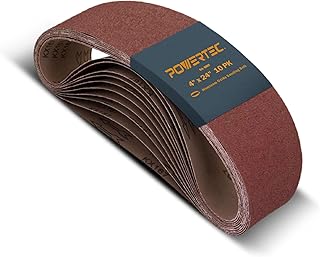
Grit: 80. Backed by a high-quality X-Weight clothed backing and open-coat aluminum oxide grain, these belts offer balanced aggression and durability. The resin-on-resin bond enhances long-term performance, while heat and moisture resistance support longer runs.
- Best for: Woodworking tasks requiring steady material removal with durable wear resistance.
- Why chosen: The belt construction aims to maintain shape and performance under typical shop conditions.
- Caution: Performance may vary with nonferrous metals; intended primarily for wood and similar materials.
4 x 24 Inch 80 Grit Sanding Belt 12 Pack
Grit: 80. This belt provides a balanced option between material removal and surface finishing. It is designed to withstand heat buildup and maintain integrity through longer sanding sessions.
- Best for: General woodworking with a need for consistent 80-grit performance.
- Why chosen: Works well as a standard-workhorse belt for routine shop tasks.
- Caution: Prolonged use on very hard materials may require occasional belt changes to avoid glazing.
Buying Guide: Key Purchase Considerations
- Grit range: Choose a mix of coarse, mid, and fine grits for full prep cycles, from rough stock removal to fine smoothing.
- Grain and backing: Aluminum oxide with a durable backing is common; look for open-coat or closed-coat depending on material and heat buildup.
- Size compatibility: Verify your sander’s belt width (4 inches) and their loop or seam construction to avoid fit issues.
- Seam integrity: Diagonal lap splice belts resist tearing; ensure the belt interface will hold under load.
- Intended materials: Some belts perform better on wood, others on metal or composite surfaces; match to project types.
Frequently Asked Questions
- What grit should I start with for new wood surfaces? Answer: Start with a coarse grit like 80 or 100 to remove roughness, then move to 150 or 180 for finishing.
- Are aluminum oxide belts universal for wood and metal? Answer: They are common for wood and soft metals; check sander compatibility and usage guidelines for harder metals.
- Can belts wear out quickly on rough stock? Answer: Yes, belts experience faster wear with hard or abrasive stock; rotate belts and inspect for glazing or tears.
- Is a mixed-grit pack better than single-grit belts? Answer: For varied tasks, a mixed pack reduces belt changes and keeps the workflow smooth.
- What is the advantage of a diagonal lap splice? Answer: It improves belt durability by providing a stronger seam that resists unraveling under stress.