Best 1.5 Inch Drill Bit Options for Your Projects
Looking for a reliable 1.5 inch drill bit or hole saw to tackle wood, metal, plastic, or drywall? This guide highlights five top choices and clarifies who each is best for. The selections emphasize durability, clean cuts, and ease of use, helping you pick the right bit for your project type and material. Below is a quick buyer’s table to compare key points at a glance.
| Product | Best For | Material | Notes |
|---|---|---|---|
| VIKITON 1-1/2″ Hole Saw | General-purpose woodworking and light metalwork | Bi-metal (HSS teeth) | Includes arbor and pilot bit |
| Jorgensen 1-1/2″ Spade Drill Bit | Fast, straight wood drilling | Carbon steel | Self-feeding tip helps prevent wandering |
| Qjaiune 1-1/2″ Forstner Bit | Precise, clean holes in wood | Tungsten carbide | Centering spur for accuracy |
| IRWIN 1-1/2″ Speedbor Bit | Fast through-hole drilling in wood | High-impact steel | Designed for quick larger holes |
Note: Use the table to identify which product best matches your material and hole quality needs. For applications requiring ultra-clean edges or precise centering, Forstner and spade designs offer distinct advantages. For faster, broader through-holes in wood, Speedbor and hole saw options are often preferred.
VIKITON 1-1/2″ Hole Saw for Wood, Metal, Plastic & Drywall

Product overview: This bi-metal hole saw uses high-speed steel teeth and a flexible steel body to deliver durable, sharp cutting across wood, metal, plastic, and drywall. The included arbor, replacement pilot bit, hex key, and extra components support a full setup in a single package. Best for DIYers and professionals who value a complete kit and a lighter, user-friendly tool for mid-sized holes.
- Best for: General carpentry, cabinetry, and light metal tasks where a hole saw is preferred over a drill bit.
- Why selected: Comprehensive package and durable bi-metal construction enhance longevity and reduce bite resistance during cutting.
- Caution: The kit adds weight via multiple components; consider your drill’s capacity for extended use.
Jorgensen 1-1/2″ x 6″ Spade Drill Bit

Product overview: This spade bit features a self-feeding threaded tip to minimize wandering and to speed drilling in wood. Double cutting spurs reduce breakout for cleaner holes, and a robust carbon steel body supports demanding woodworking, electrical, and plumbing tasks. Best for quick, larger-diameter holes in softwood and plywood.
- Best for: Fast, straight-hole wood drilling with clean edges.
- Why selected: Self-feeding tip and double spurs reduce tear-out and improve hole quality.
- Caution: Not ideal for metal or hard hardwoods where shear strength matters most.
Qjaiune 1-1/2″/38mm Forstner Bit

Product overview: This Forstner bit uses tungsten carbide with a special heat treatment for a sharp, durable cutting edge. It delivers clean, accurate holes with a low-resistance cut, aided by a centered spur and two spurs for supported chip removal. Best for precise, flat-bottom holes in hardwoods and softwoods alike.
- Best for: Precise, decorative, or joinery holes needing flat bottoms and clean edges.
- Why selected: Carbide and heat-treated edge provide sharp cutting life and improved accuracy.
- Caution: Forstner bits can be slower than standard bits on very dense woods or metals.
IRWIN SPEEDBOR 1-1/2-Inch Drill Bit
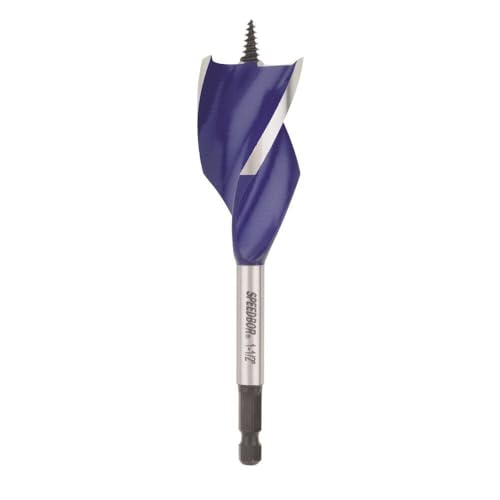
Product overview: The IRWIN Speedbor bit is designed for rapid hole completion in wood, with a focus on fast through-holes. The listed dimension implies a standard length suitable for many carpentry tasks. Best for: Quick, middle-depth holes where speed is a priority.
- Best for: Fast-through-hole drilling in softwoods and common lumber.
- Why selected: The Speedbor design emphasizes swift chip removal and deeper penetration.
- Caution: May not provide the same precision as Forstner or spade bits for decorative work.
Buying Guide
Key considerations when choosing a 1.5 inch drill bit or hole saw set include material compatibility, hole quality, and the type of work you perform most often. Here are practical questions you’ll likely ask:
- What material will I drill? For wood, consider spade, Forstner, or Speedbor; for metal, look for bi-metal hole saws with durable teeth.
- Do I need a complete kit or a single-purpose bit? Complete kits offer multiple components, saving setup time.
- Is clean edge crucial? Forstner bits deliver flat-bottom holes with cleaner edges, while spade bits can wander without a pilot guide.
- What drill capacity and power do I have? Heavier hole saws require stable setups and adequate torque.
- What is the priority: speed, accuracy, or versatility? Match the bit design to the project goals—fast holes vs. precise holes.
Frequently Asked Questions
- What is a 1-1/2 inch drill bit best used for? It covers large-diameter through-holes in wood, metal, or composite materials, depending on bit design.
- Are Forstner bits better than spade bits for precision? Yes, Forstner bits typically offer cleaner, more accurate holes with flat bottoms.
- Can I drill through metal with a 1-1/2 inch hole saw? Some bi-metal hole saws are designed for metal; verify if the product explicitly supports metal drilling.
- Do I need a pilot drill for larger bits? Pilot bits can help align and start holes, reducing wandering, especially with spade and Forstner bits.
- How do I prevent tear-out on wood when using large bits? Use sharp bits, feed slowly, and use backing material or a sacrificial board to support the workpiece.
- Is carbide better than high-speed steel for drill bits? Carbide is harder and retains edge longer but is more brittle; HSS is tougher and more forgiving.